| Forster Dennis Gallery: February 16 - April 17, 2026 |
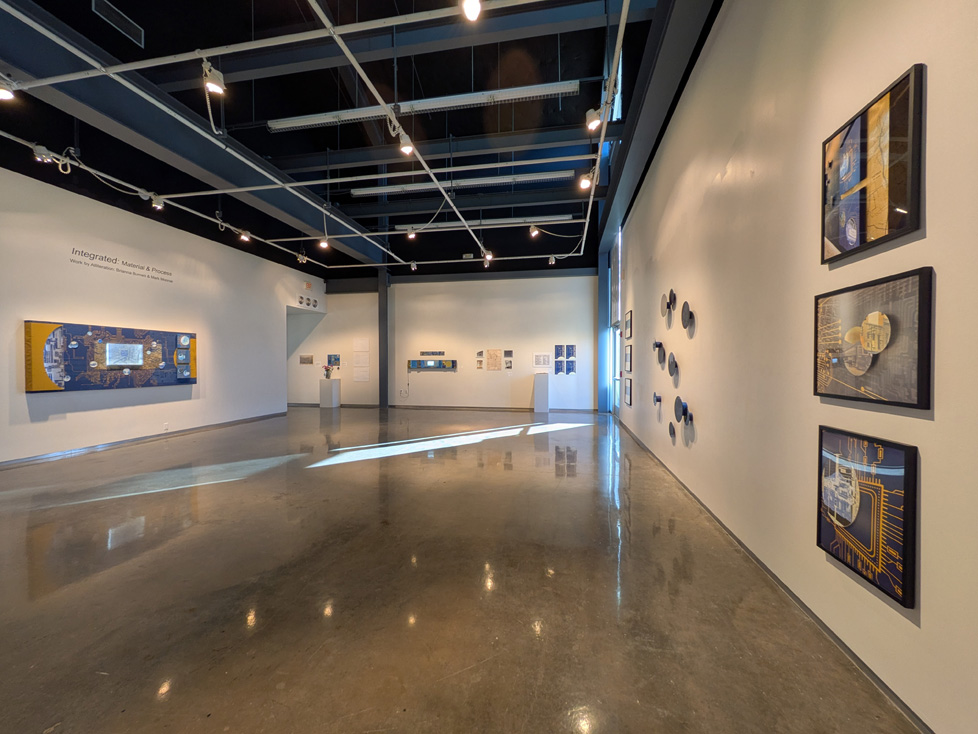
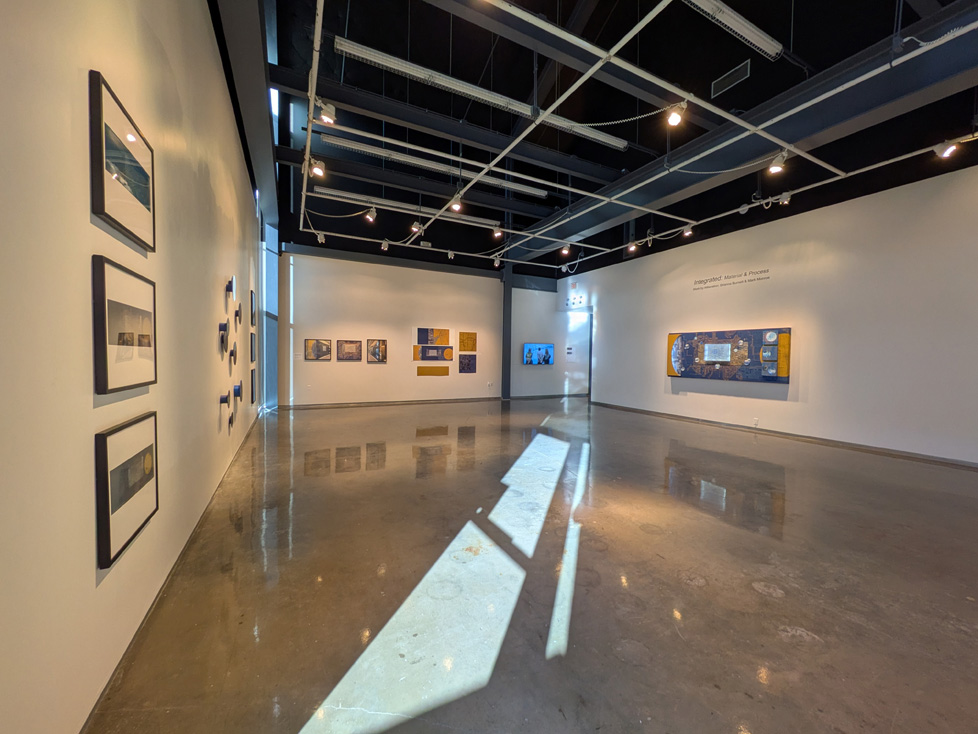
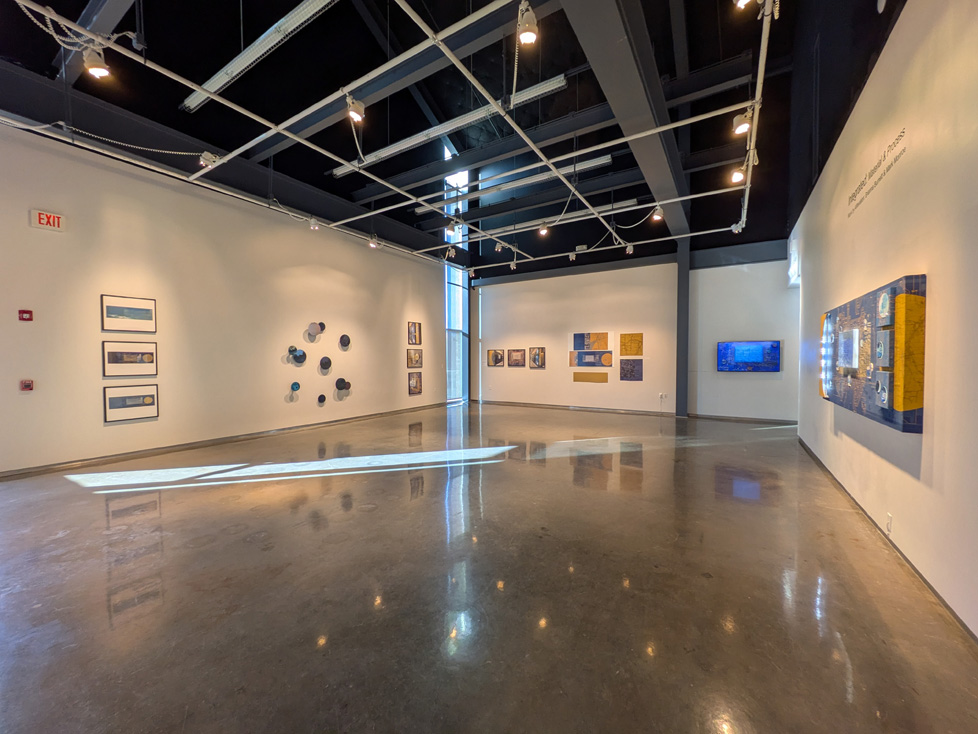
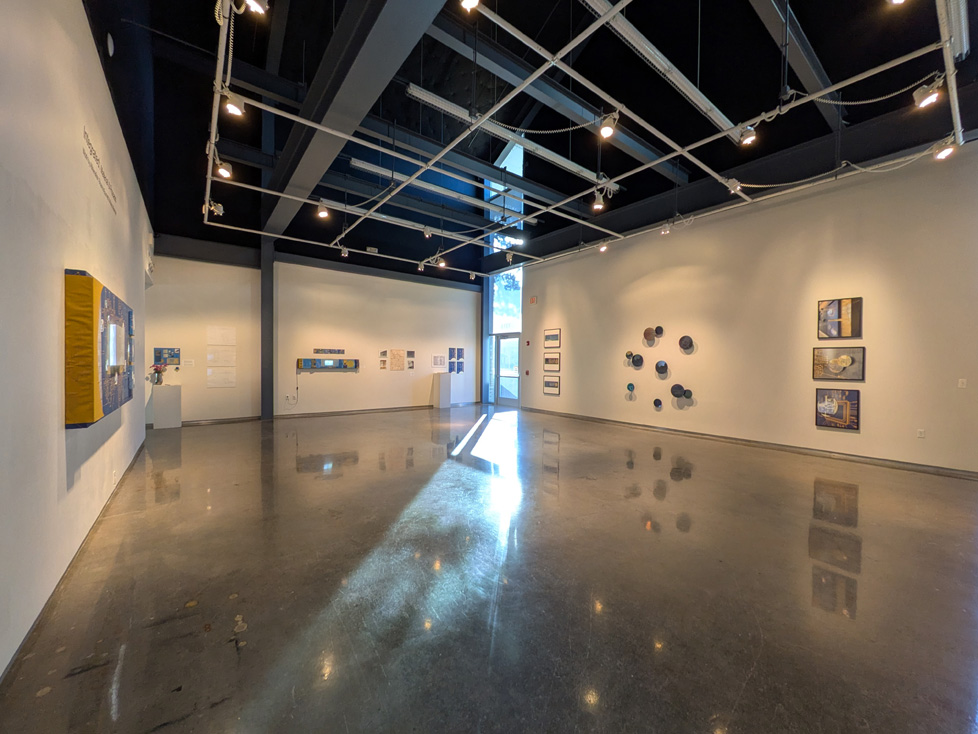
Alliterations is a creative collaboration comprised of artists Brianna Burnett and Mark Monroe. Integrated: Materials and Process documents the steps and decisions made during the making of a commissioned mural located at Texas Instruments new campus in Sherman, TX. The originating call for this project was a mural that would highlight the symbiotic partnerships between the city of Sherman and Texas Instruments as a partnership that started into the past and is projected well into the future of the city. The framework of these partnerships is based in a protracted history of time and place. For the artists, their proposed mural would tell a layered story of land, of industry, and of transformation The genesis point of this proposal was the historic map created in 1891 and hand-drawn from sketches collected on site. Inspecting this historic map reveals a bustling town of businesses, churches, colleges, roads and railroad lines that were important to Sherman's future. Wagons clustered around the courthouse demonstrate how Sherman was a hub of activity for the westward expansion. |
 |
 |
 |
 |
| Alliterations - Artists Biography Alliterations is the creative collaboration of Mark Monroe and Brianna Burnett, two artists and educators whose complementary practices merge sculpture, photography, and material culture into a unified exploration of place, memory, and narrative. Mark Monroe is a sculptor and educator at Austin College in Sherman, Texas, with a national exhibition record. His practice centers on the re-use of materials, the culture of space, and the interaction with historical objects. His work has been exhibited at prestigious venues throughout Texas and in selected regional and international museums and galleries. Brianna Burnett is a visual artist and Assistant Professor at Austin College with a studio background in photography, digital media, and creative practice. Her work explores themes of identity, storytelling, place, and history, with particular focus on the re-telling of narratives. Her studio practice emphasizes how the arts provide unique perspectives in our technologically evolving world. Together as Alliterations, Mark and Brianna create work that bridges the tactile and the visual, the historical and the contemporary, inviting audiences to reconsider the stories embedded in materials, spaces, and images. |
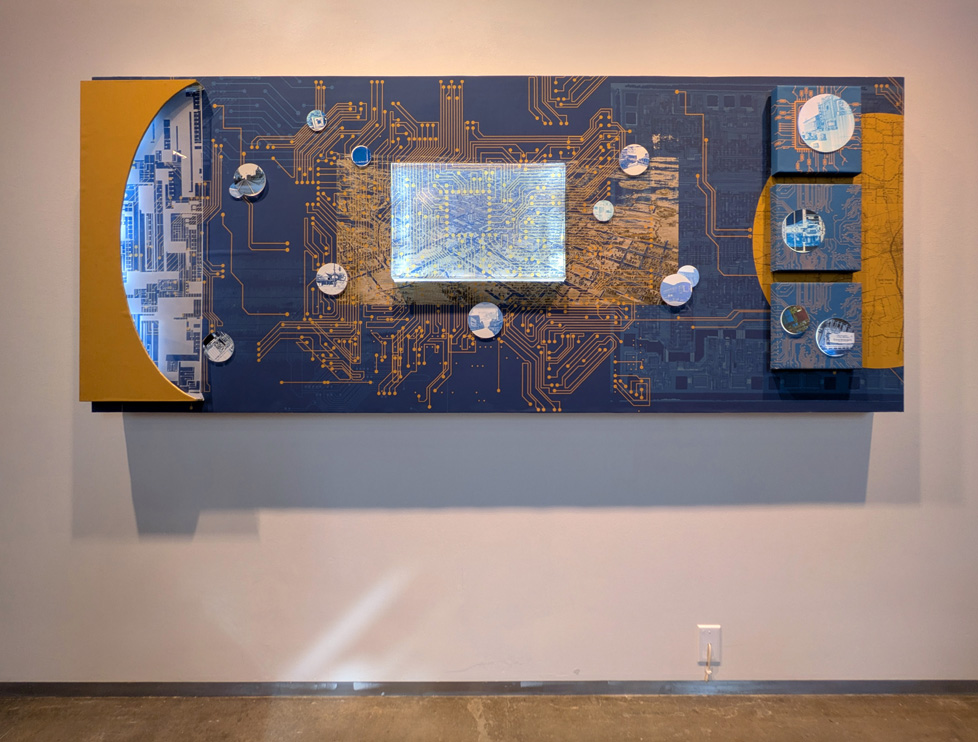 Integrated, scale model Mixed media mural including historical images, texts, maps, and semiconductor wafers 103"x42", 2025 Original installed as part of the Texas Instruments Art Collection 34'x12'x3' Integrated explores the intersections of history, technology, and place, using layers and dimensional elements to reveal how memory and progress shape a community identity. By merging archival photographs, abstracted semiconductor graphics, and cityscape motifs, this installation emphasizes the unseen connections between place and progress. The use of historic photographs and industrial records anchor this concept, mapping Sherman's growth while the semiconductor components symbolize the innovation driving its future. The rhythmic structures of the present visually parallel the repetitions of history-city grids, industrial expansion, and human innovation-emphasizing the unseen connections between place and progress. This mural emerged through a process of collaboration between two artists who work together under the collaboration "Alliterations". The artists researched regional historic archives showing that this artwork has a conceptual approach framed by interdisciplinary input, and it can be seen as a visual narrative that invites imagination, curiosity, and connection. The title - Integrated - is important to the artists because of the history of this term within the semiconductor production process. An integrated chip - was prevalent in the research of this mural. In addition, the art within the mural has "integrated" the elements of history, culture and most importantly community within the visual composition. That these layers of narrative through history can be integrated into a view of progress in a community feels like a celebration of the city of Sherman and of Texas Instruments combined. |
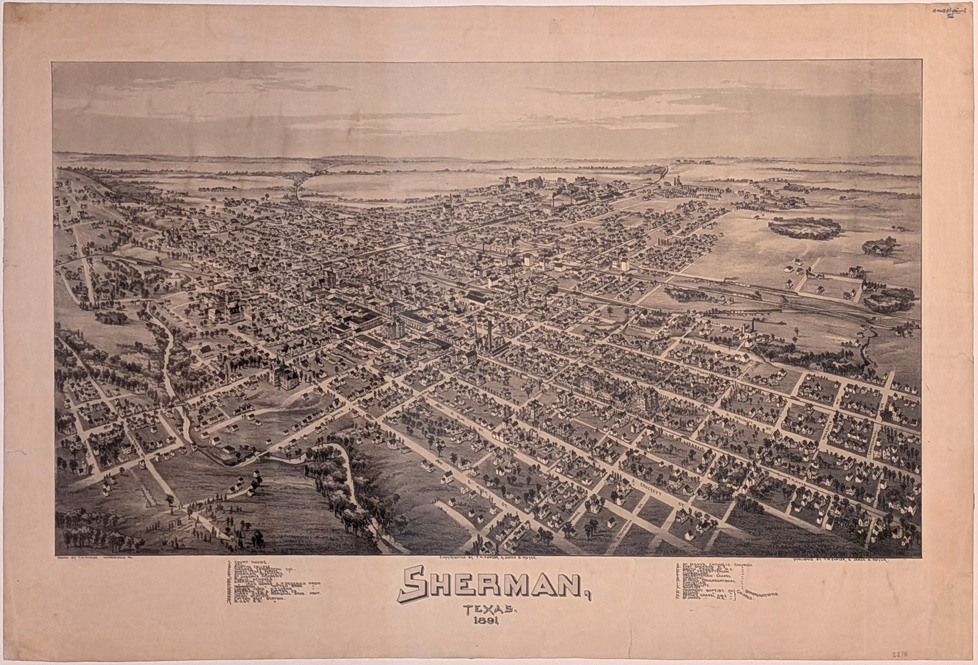 Birdseye View of Sherman, Texas Published and copyrighted by T.M. Fowler and James B. Moyer in 1891 Original: 43 cm x 80 cm, black & white, engraved, lithographed Reproduction: 17x22" Archival digital print Use with permission from: The Texas State Archives Map Collection |
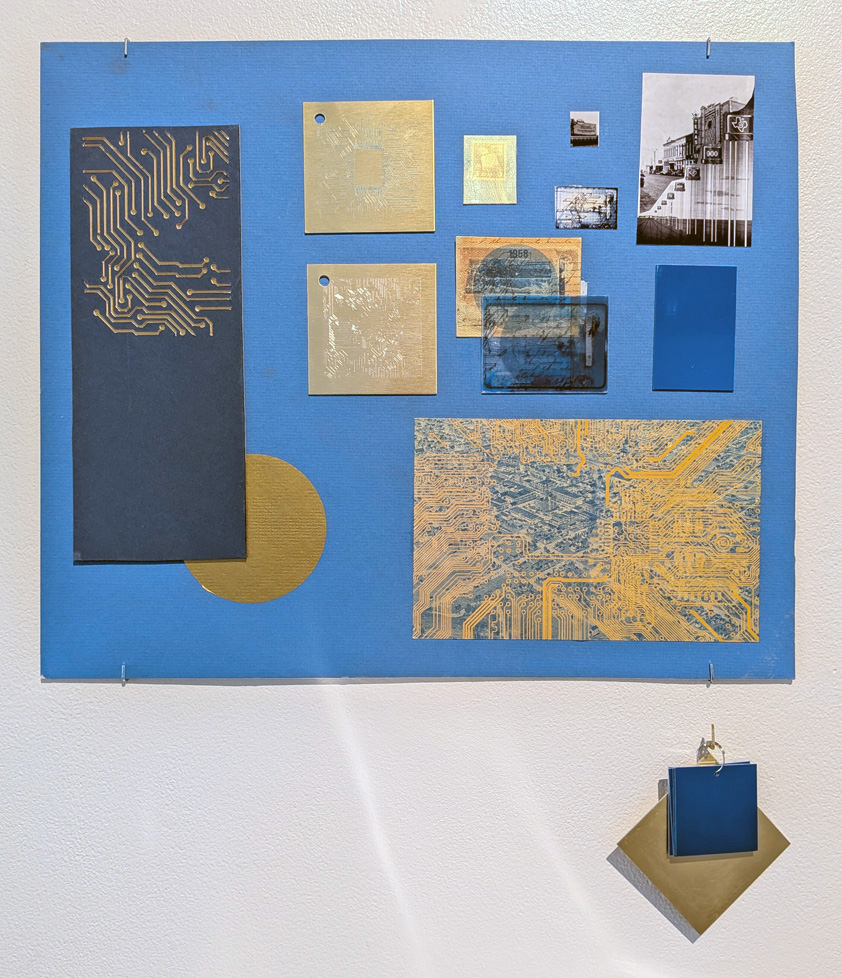 Dimensional Materials-Metal & Acrylic The mural was approached not just as a flat surface, but as a space for dimensional engagement. Etched circuit patterns allow light to interact with the surface, creating a shifting visual experience as viewers move past. On the right the circular elements (repeated throughout the mural) reference the shapes of the wafers as well as visually connect the left and right sides though a positive and negative shape. The layers of information from surface to illumination are meant to represent the process of the semiconductor wafer manufacturing which uses a photosensitive process as well as layers of materials to create the innovative designs. Photographic collages produced from archival images are dimensionally mounted throughout the mural. These images are laser printed on three sizes of actual wafers made by TI. Color as Connector For the artist the use of color was intentional - bridging old and new, warm and cool, past and future. These palettes were chosen to feel both energetic and grounded, reflecting the innovation-driven ethos of Texas Instruments while remaining rooted in the local context. It is especially important to note that the gold represents the new semiconductor processes while the blue takes consideration of a historic image from the Texas Instrument archives (seen in the background on the right-hand side) that was recorded using a 19th century photographic process called a cyanotype. This layer of blue and the abundance of gold reiterates the ideas of the long history of Texas Instruments with the potential for future developments. |
 |
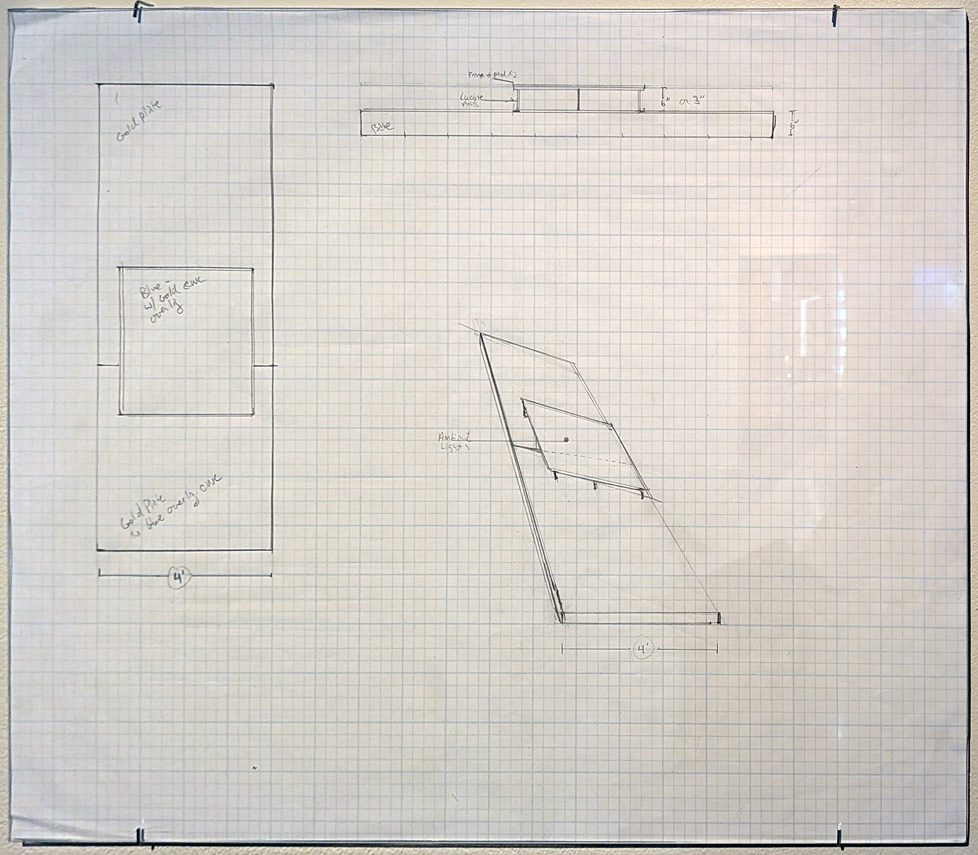 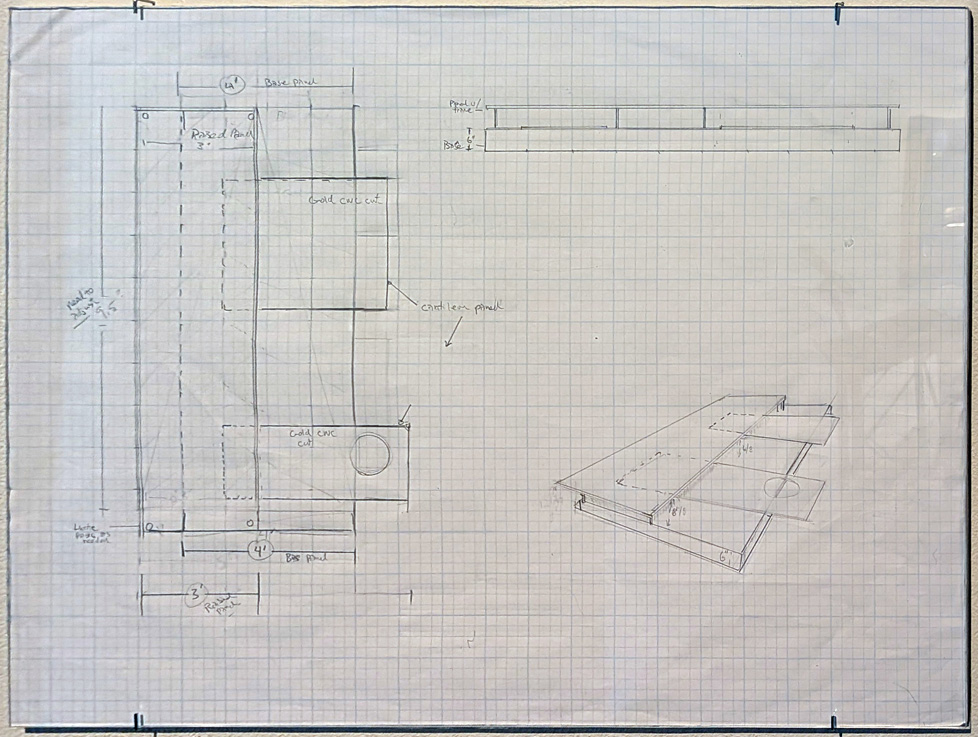 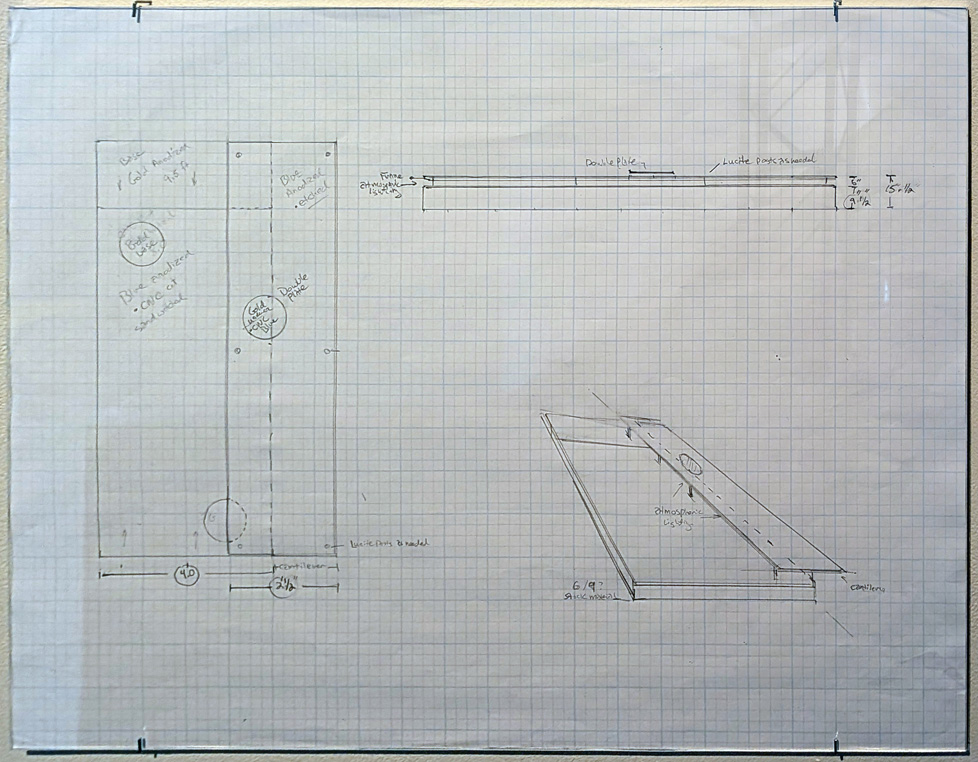 Initial sketch of design schematics Paper/pencil, 22"x17" 2025 |
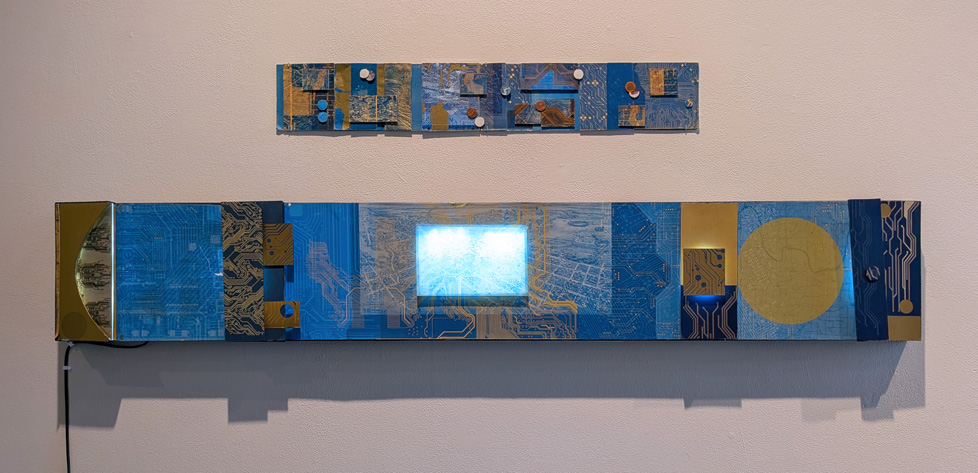 Mockup of original concept - 60 ft wall Linerboard, digital prints, metal and acrylic 31"x5", 2025 Mockup for layer and illumination Board, digital prints, acrylic, metal and lights 103"x42", 2025 |
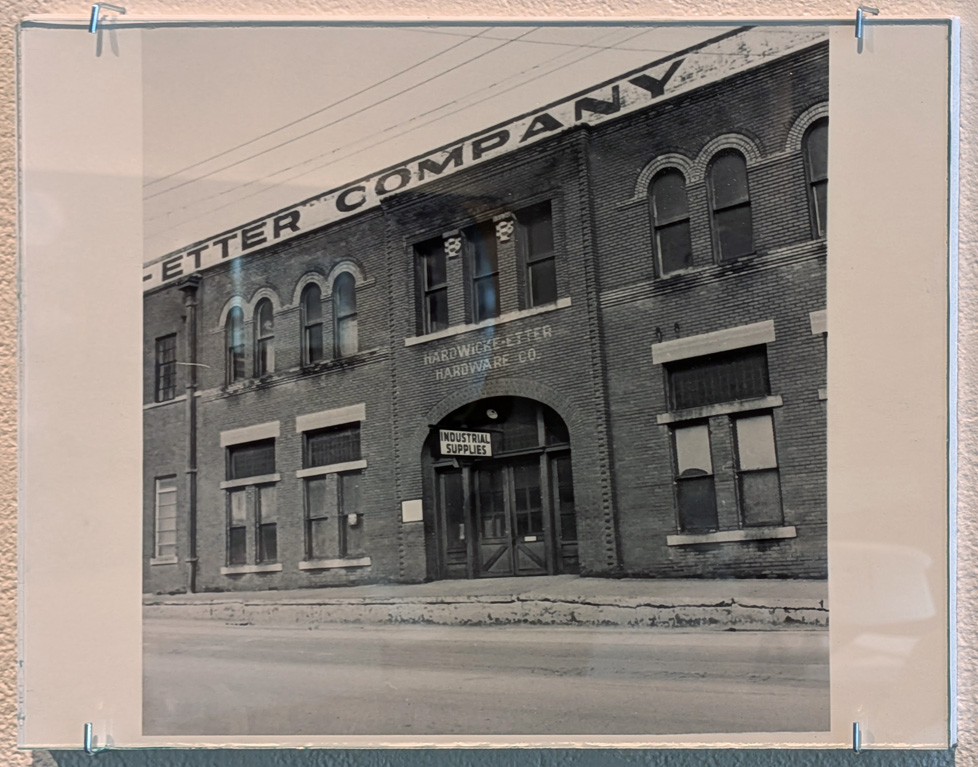 Hardwick-Etter Hardware Co. Date unknown Archival Digital Print reproduction Sherman Public Library Historic Collection |
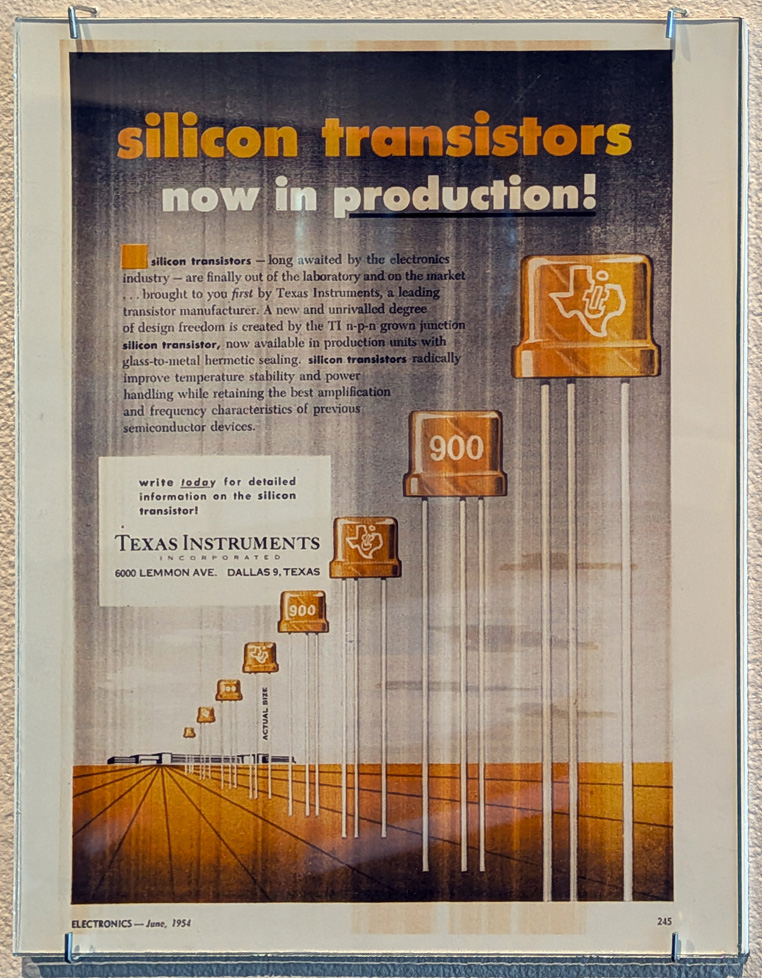 Advertisement for Texas Instruments Published June - 1954 Archival digital print reproduction The Texas Instruments Records at the DeGolyer Library - Southern Methodist University |
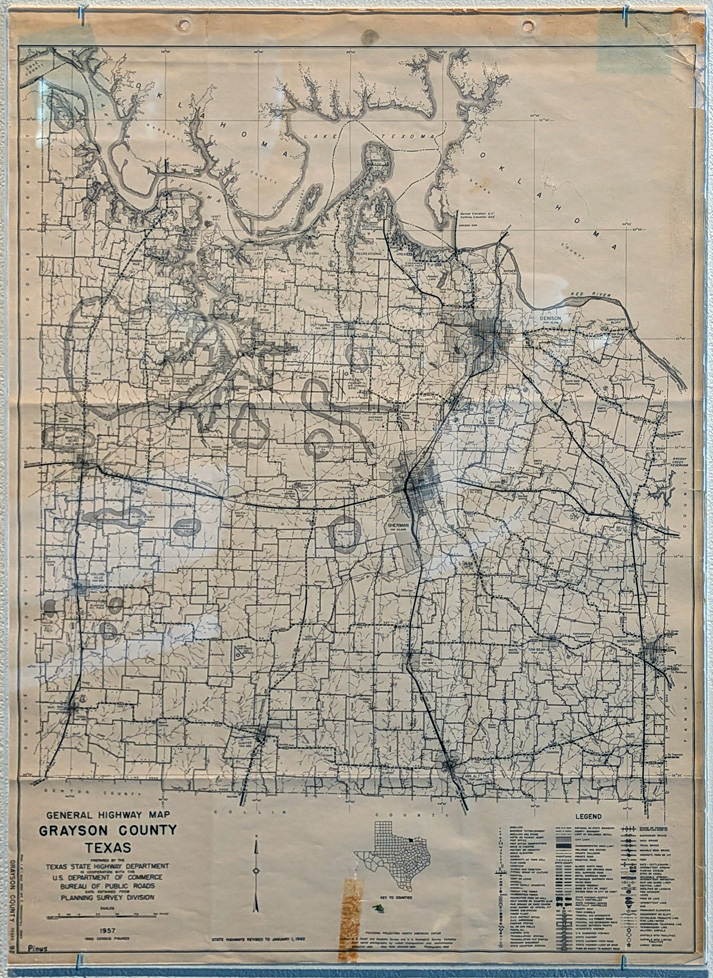 General Highway map Grayson County Texas Texas State Highway Department 1957 Original |
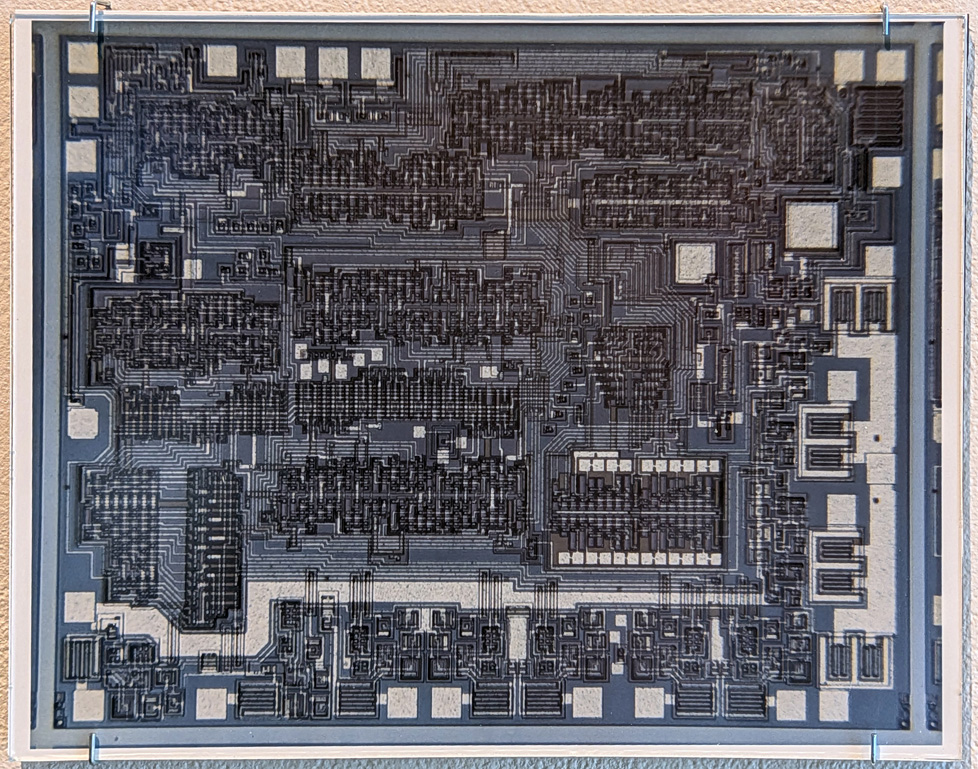 Blue schematic of a chip, ca 1980s Archival digital print reproduction The Texas Instruments Records at the DeGolyer Library - Southern Methodist University |
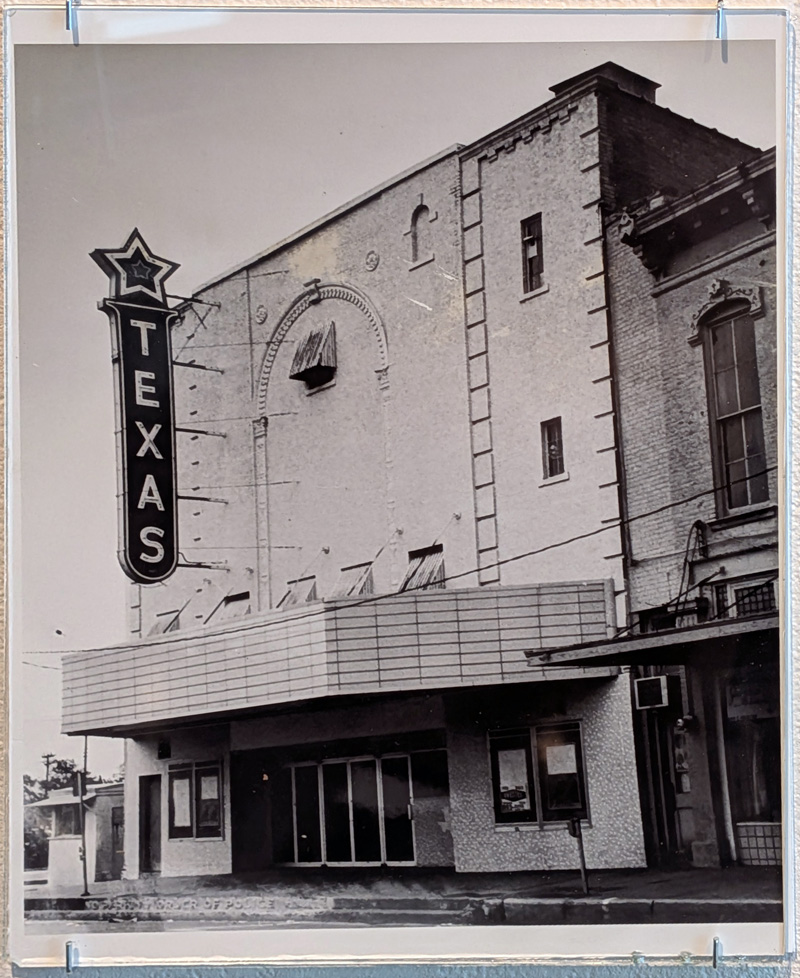 Texas Theatre Sherman, Texas, ca 1985 Archival Digital Print reproduction The Sherman Museum |
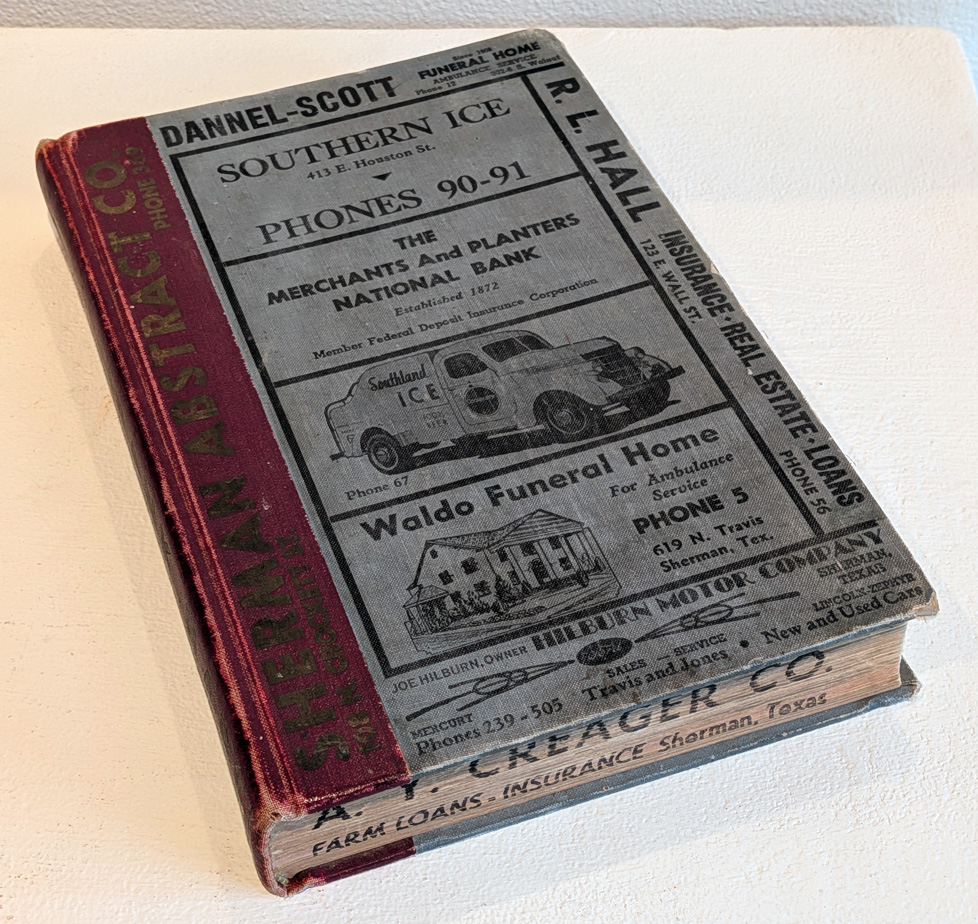 Worley's Sherman City Directory Original: ca 1942 |
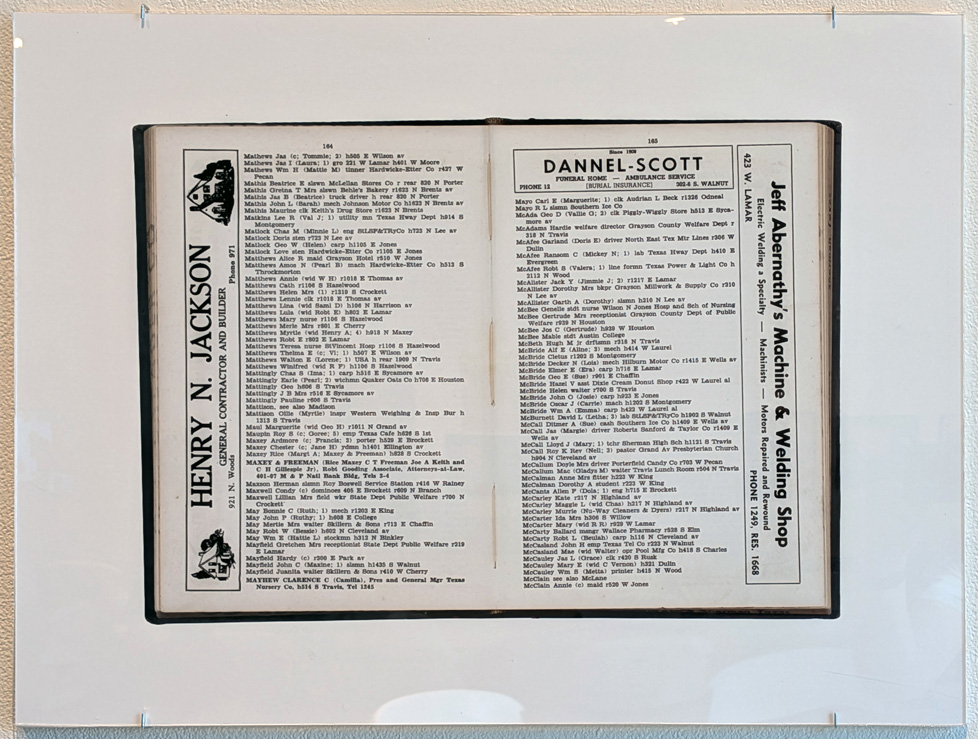 Worley's Sherman City Directory 17x22 replica Archival Digital Print |
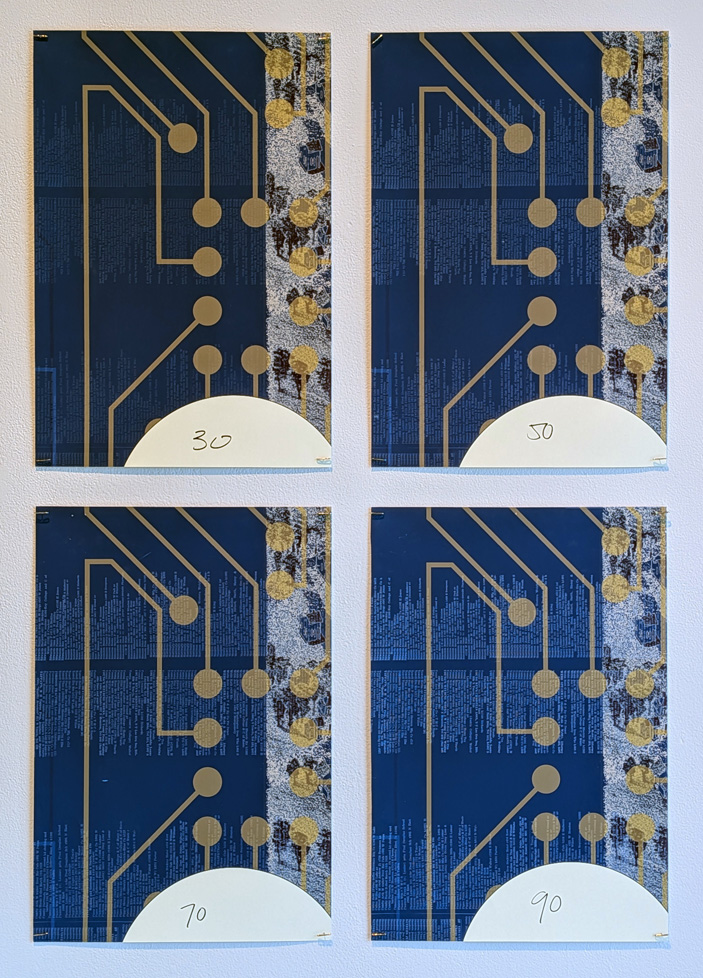 Test print for opacity and color - names/advertisements Archival digital print and sharpie marker |
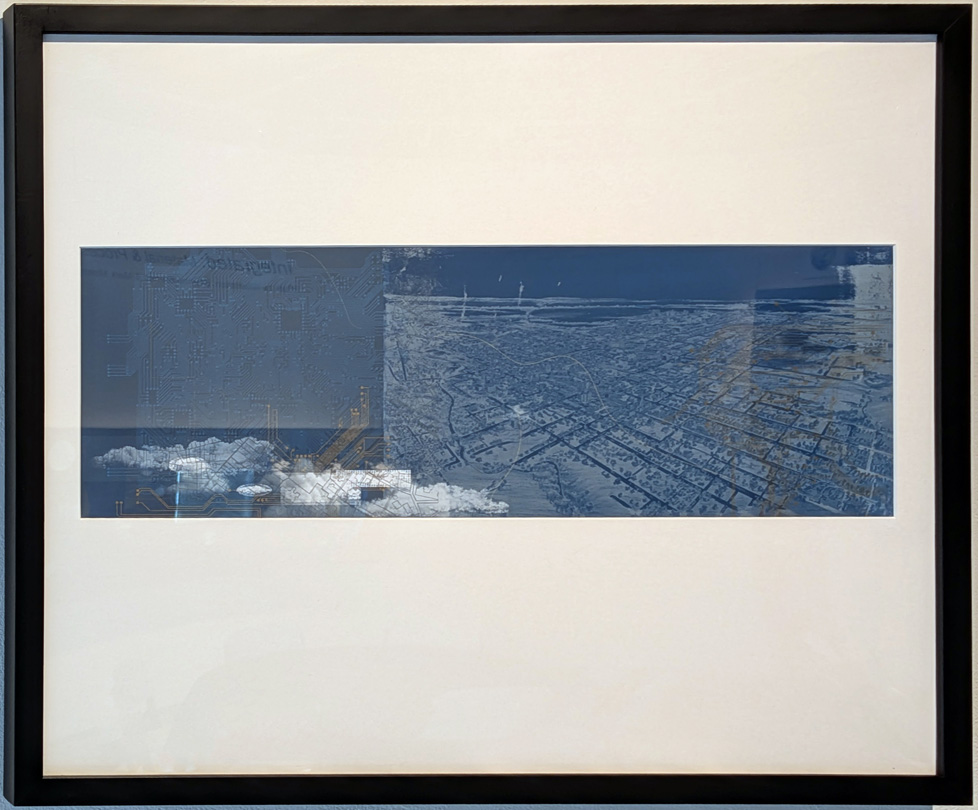 |
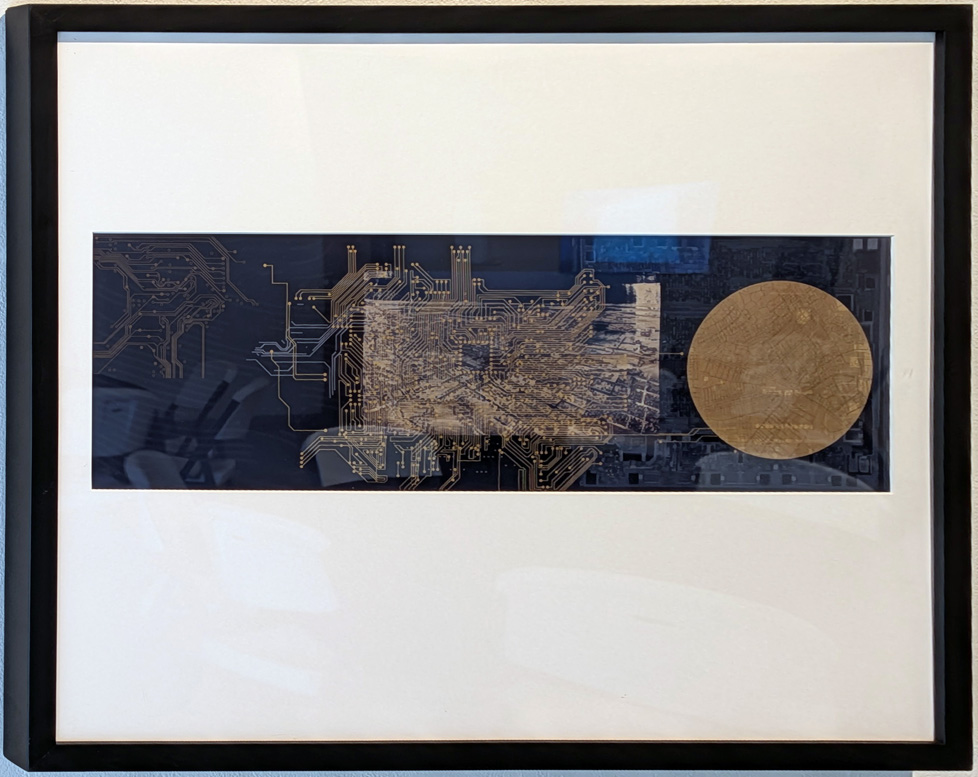 |
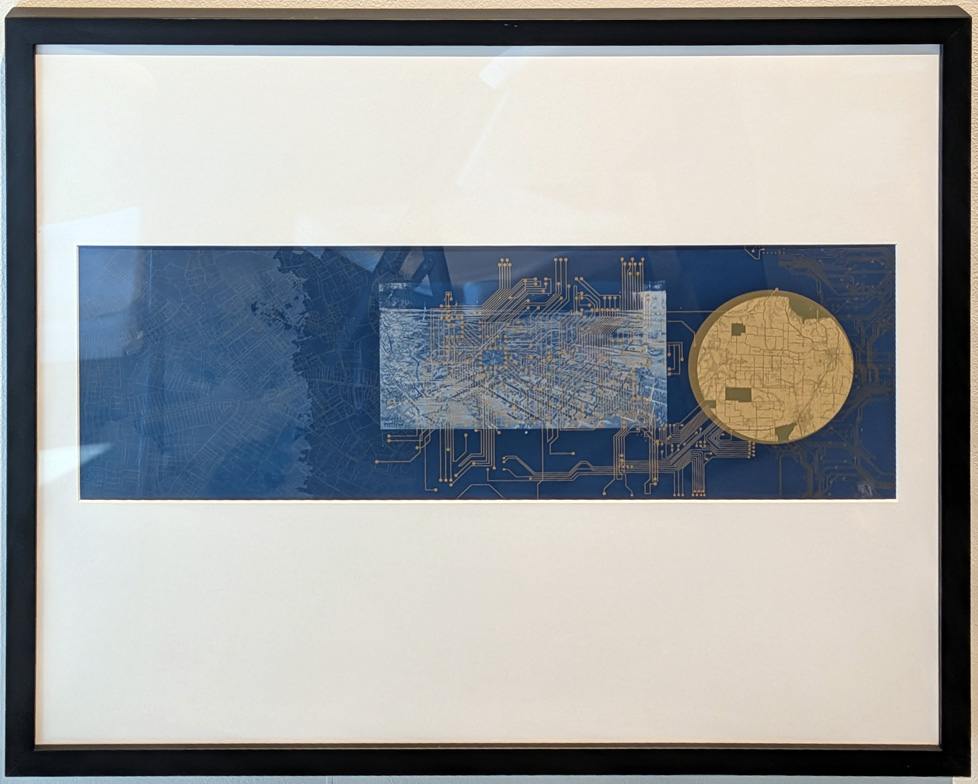 |
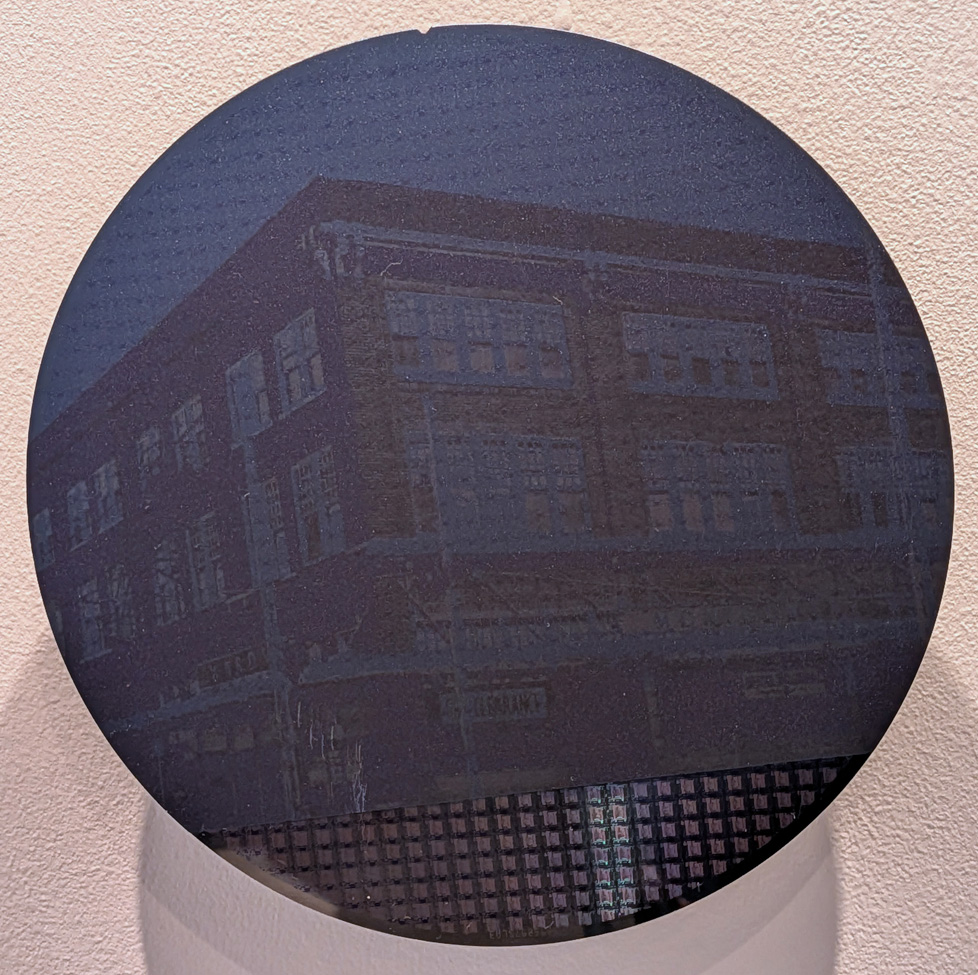
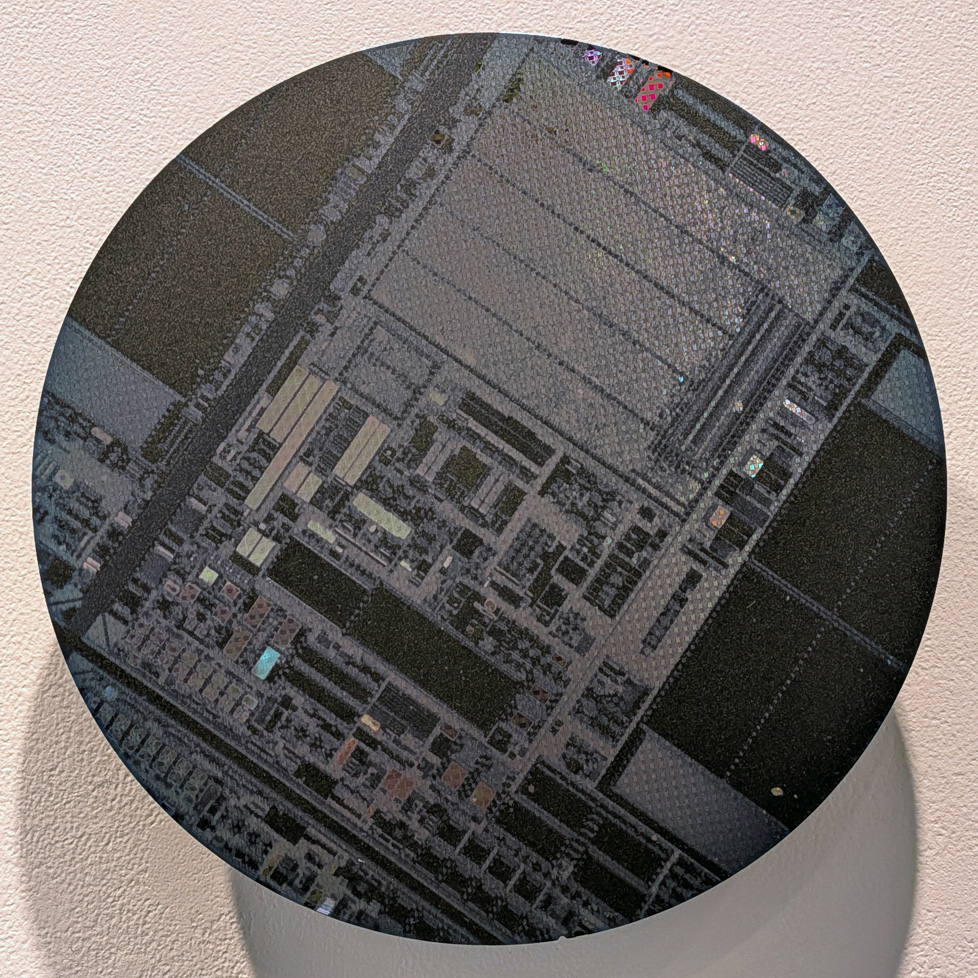
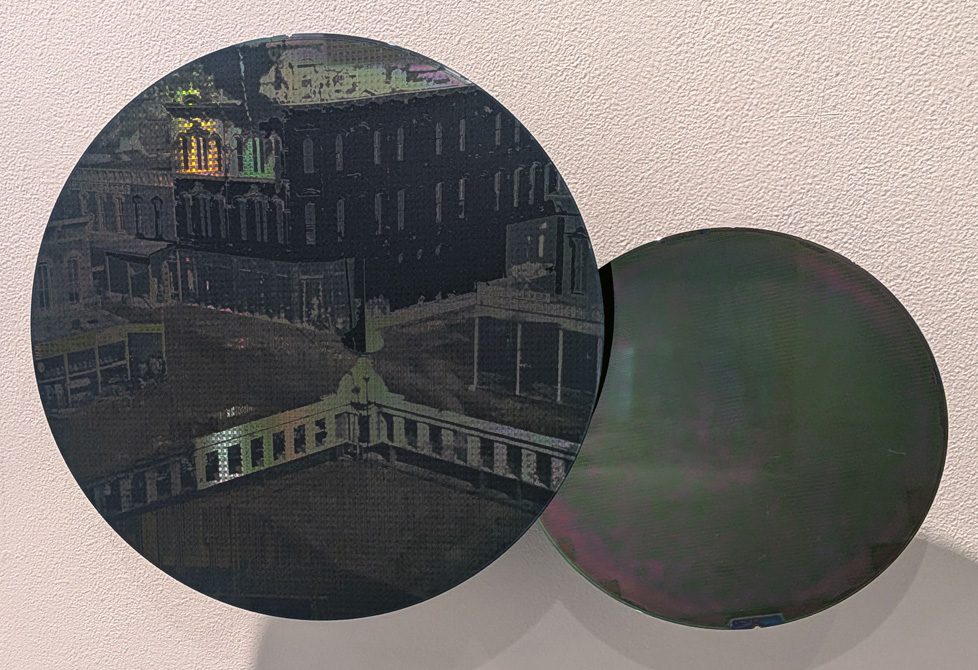
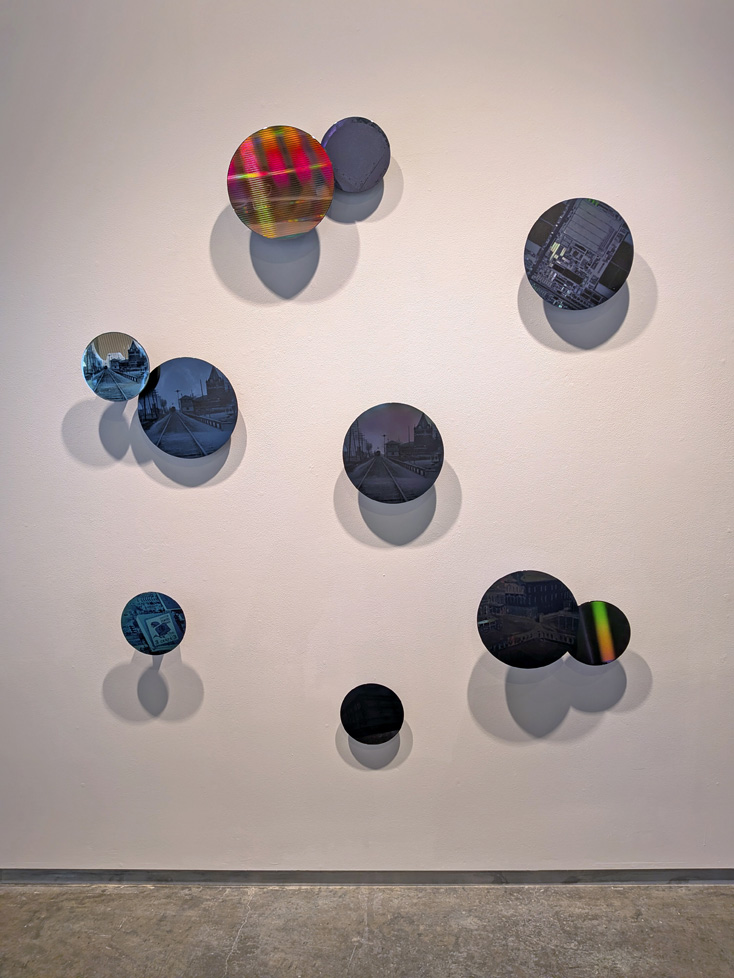 Semi-Conductor Silicon Wafers with UV-cured archival pigment print mounted with custom stands 6'x6', 2025 |
| Photographs For the artists representing the past innovations in both Sherman and Texas Instruments while symbolizing the innovation driving its future continued to be a priority. By collecting archived photographs from both city and industry the experience was as if the artists could re-interpreting history as a visual narrative. This is most evident in the historic photographic collages printed directly onto the semiconductor wafers. This Direct-to-substrate digital print allowed the images to be both transparent, which allowed the semiconductor patterns to be visible and still archival as a photographic process. By using collected historic images layered with the pattern of the wafers gives an illustration of the past paved with the semiconductors of today. |
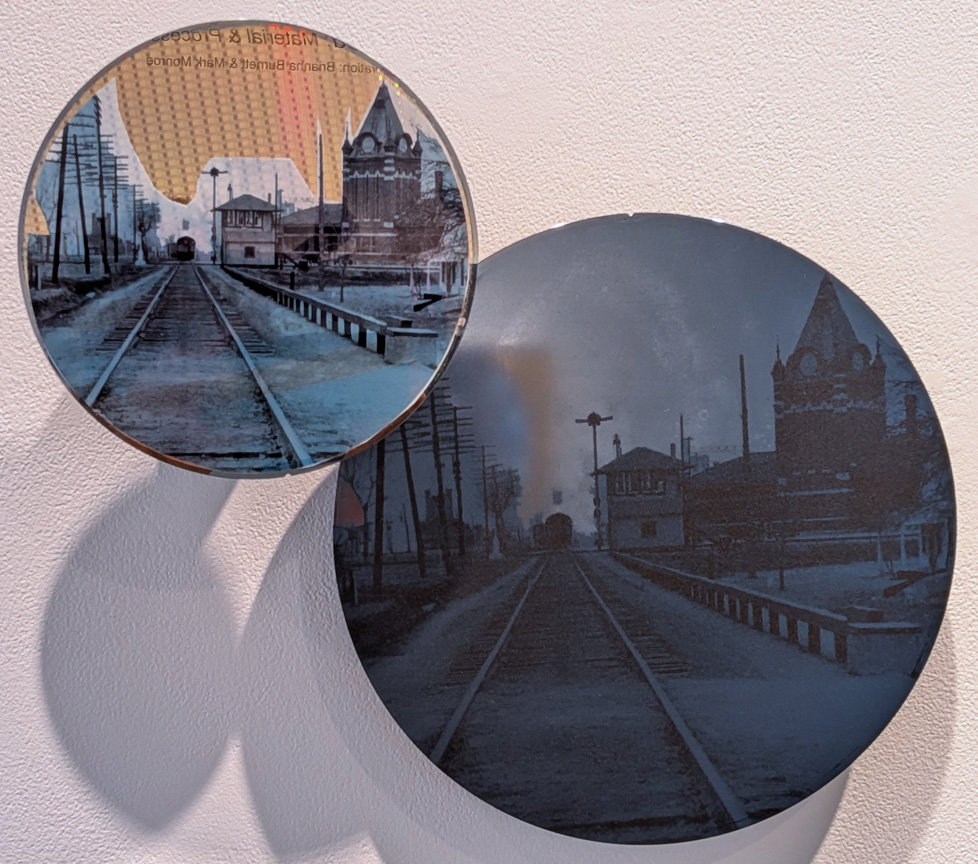 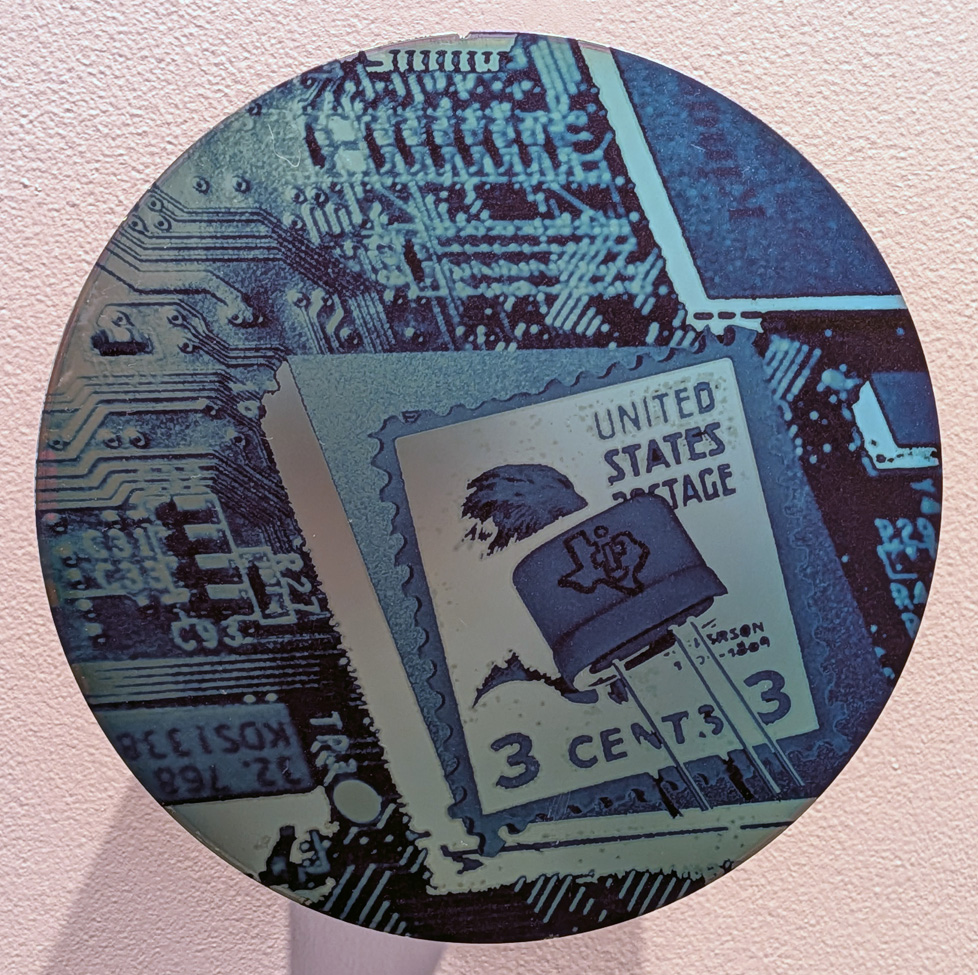 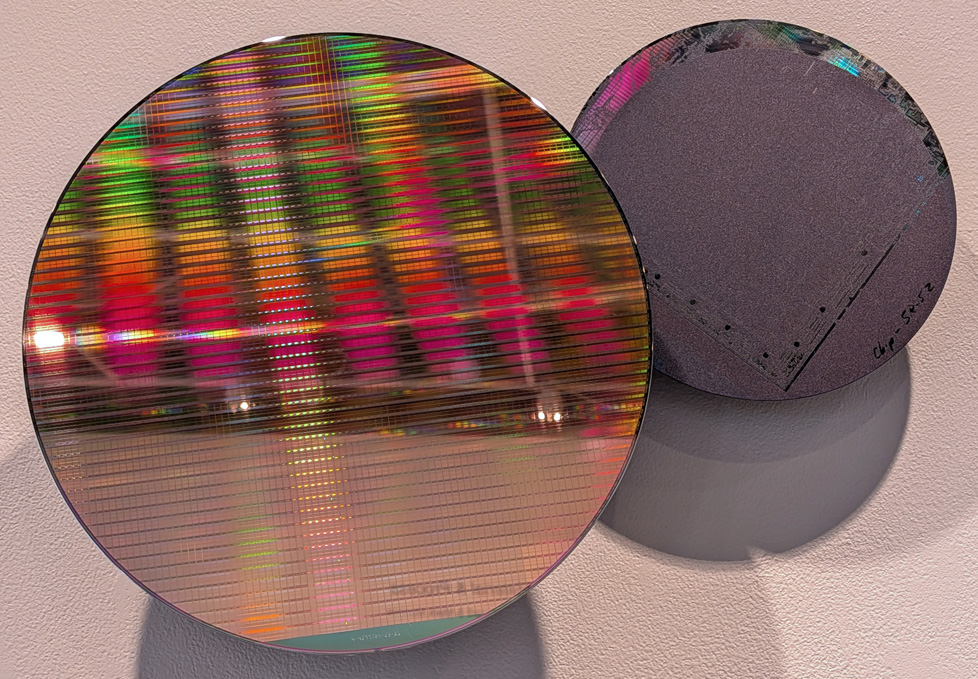 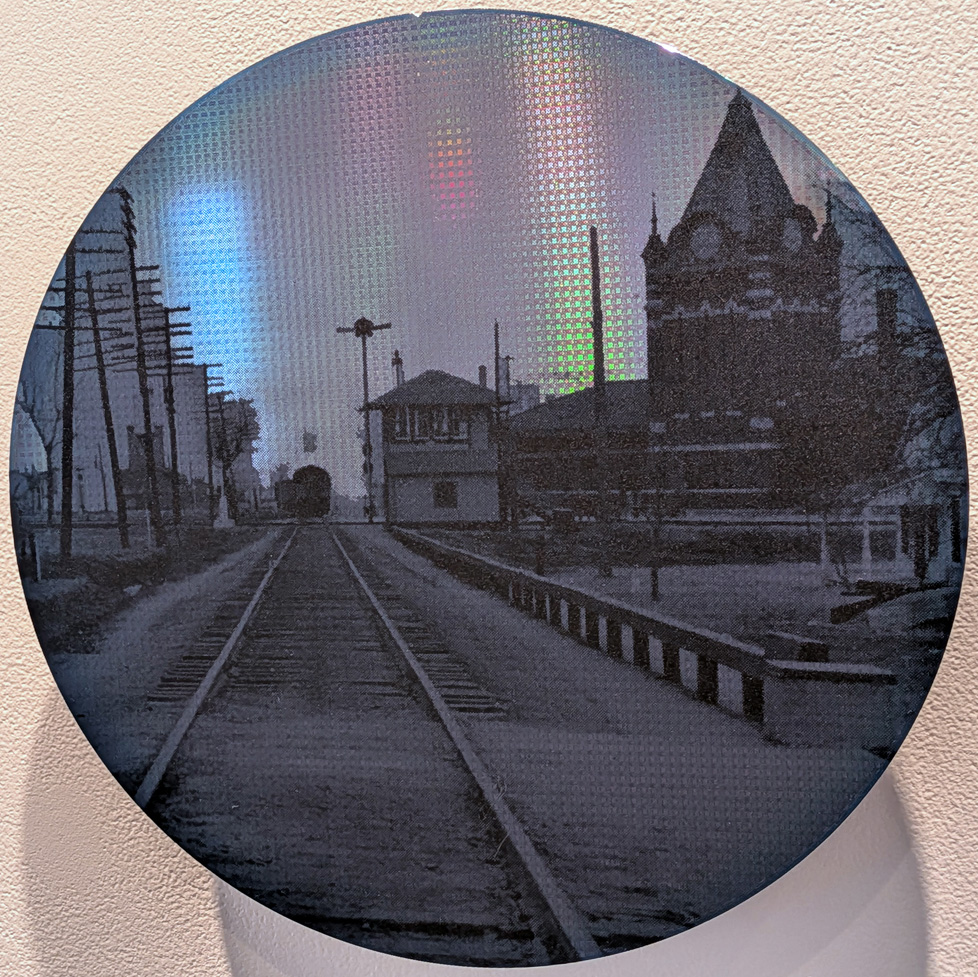    |
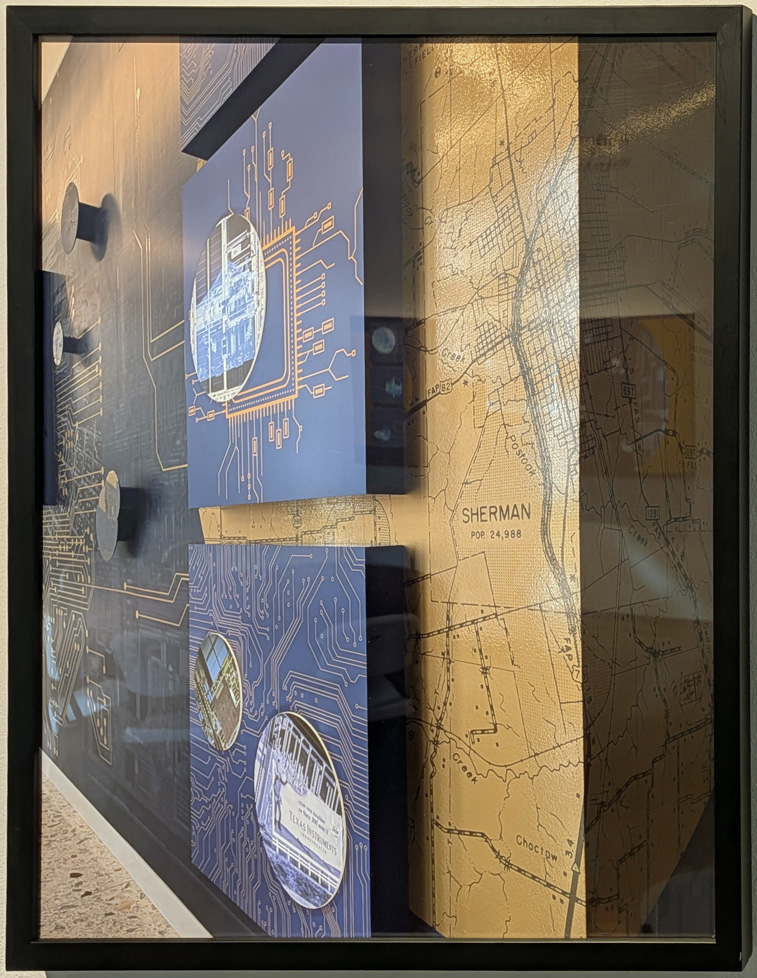 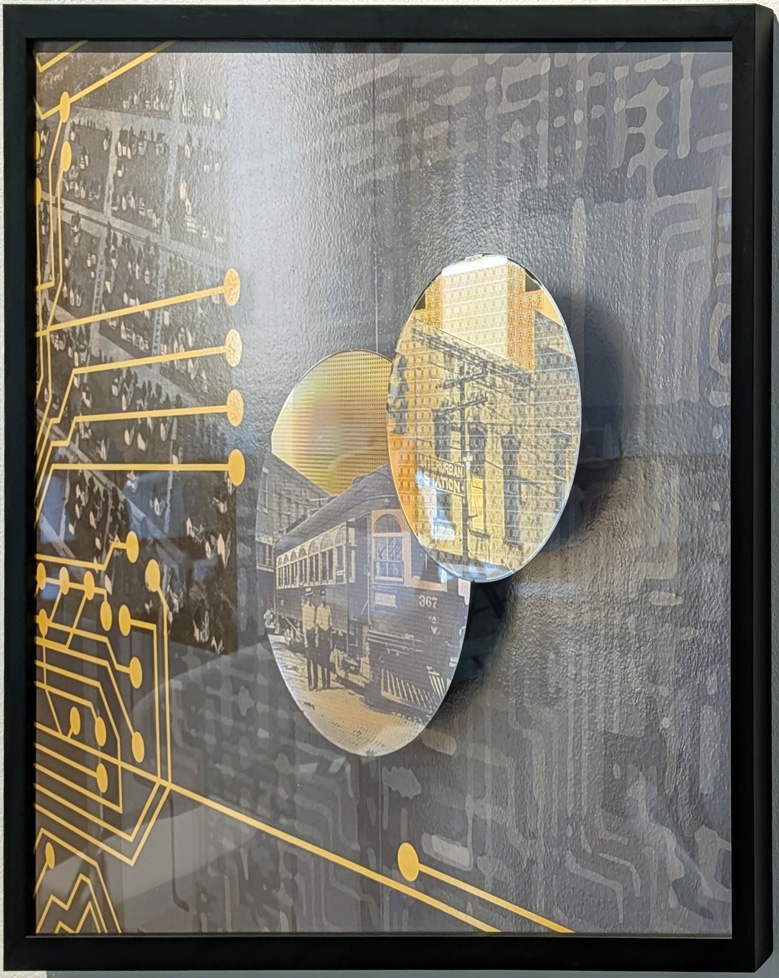 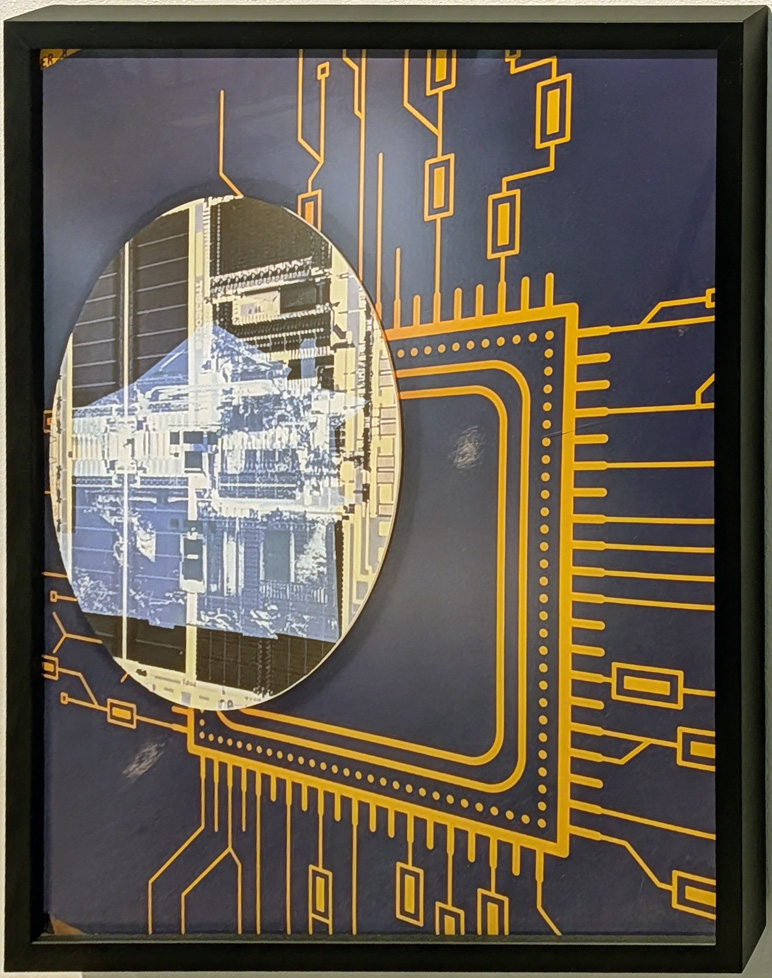 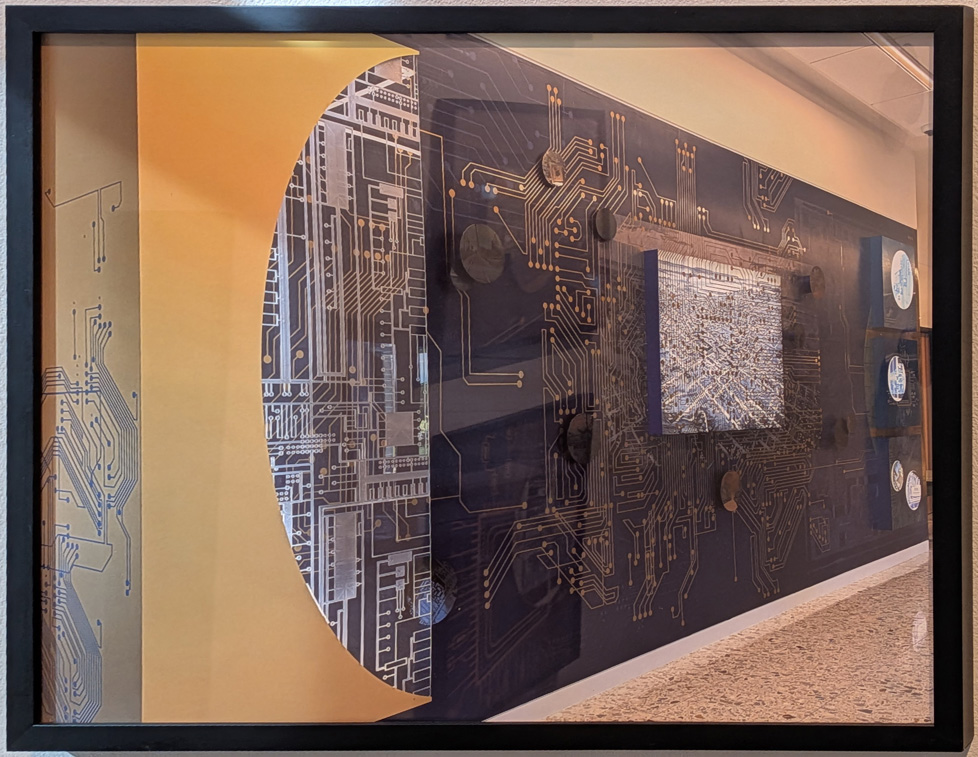 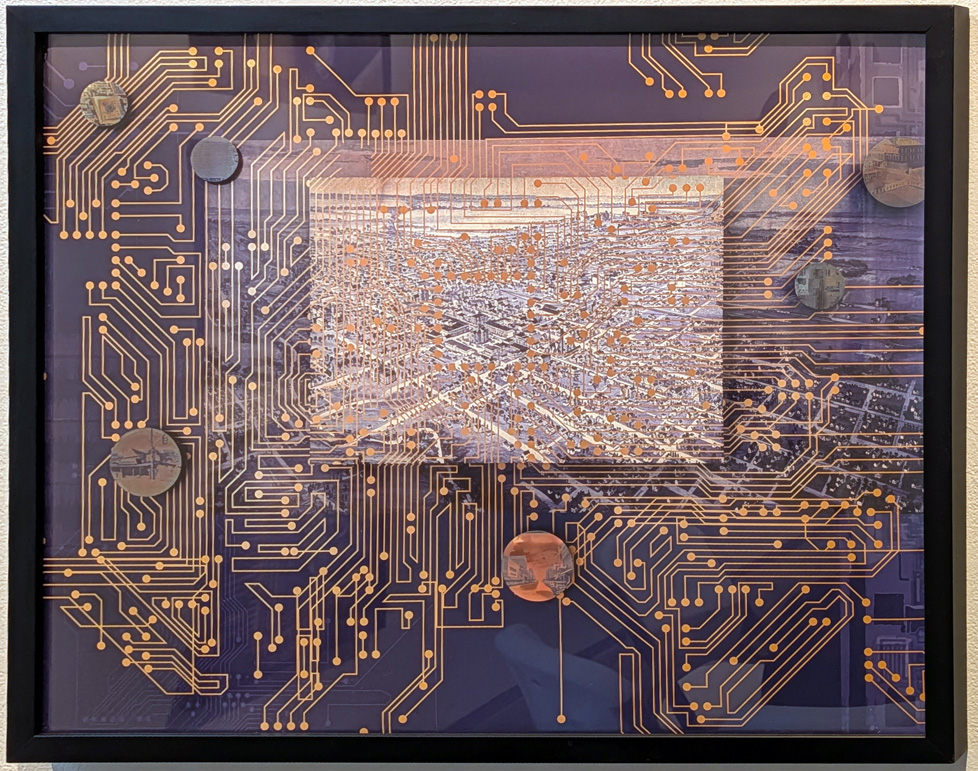 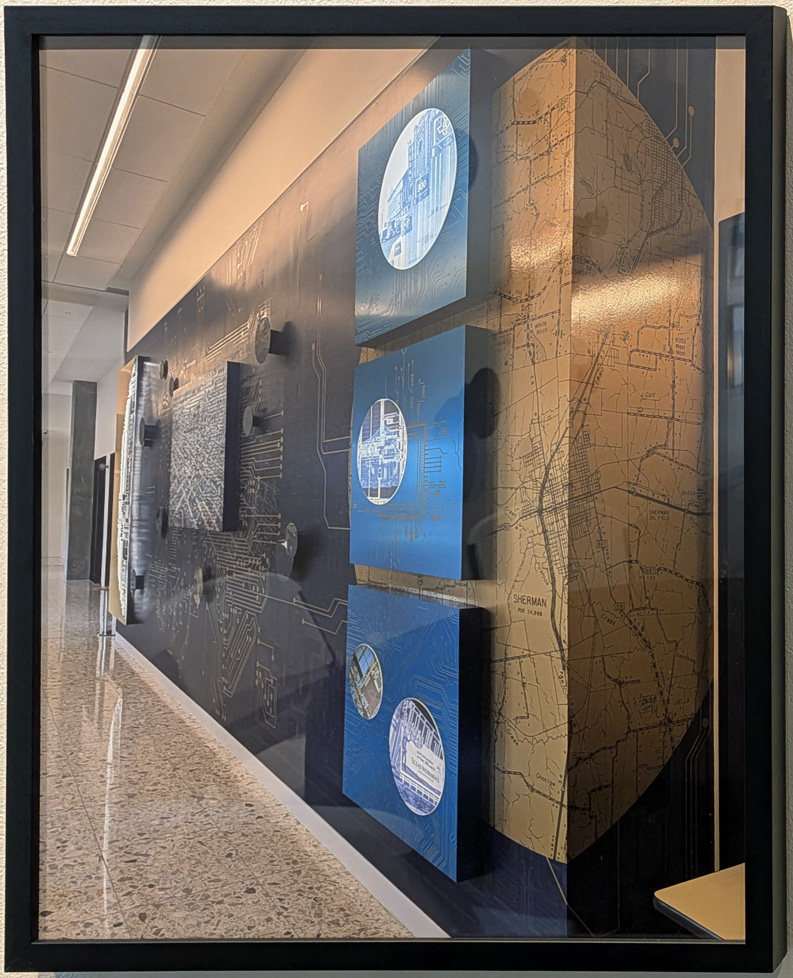 Integrated, installation images on location View from Right--Detail of illuminated acrylic disks on anodized aluminum. Semiconductor wafer chip with historic photographic collage. Illuminated acrylic disk with found image collage. View from the Left Central: 1891 map illuminated, semiconductor wafers with photographic collage and gold vinyl circuit elements. All photos-22x24, archival digital prints, 2026 |
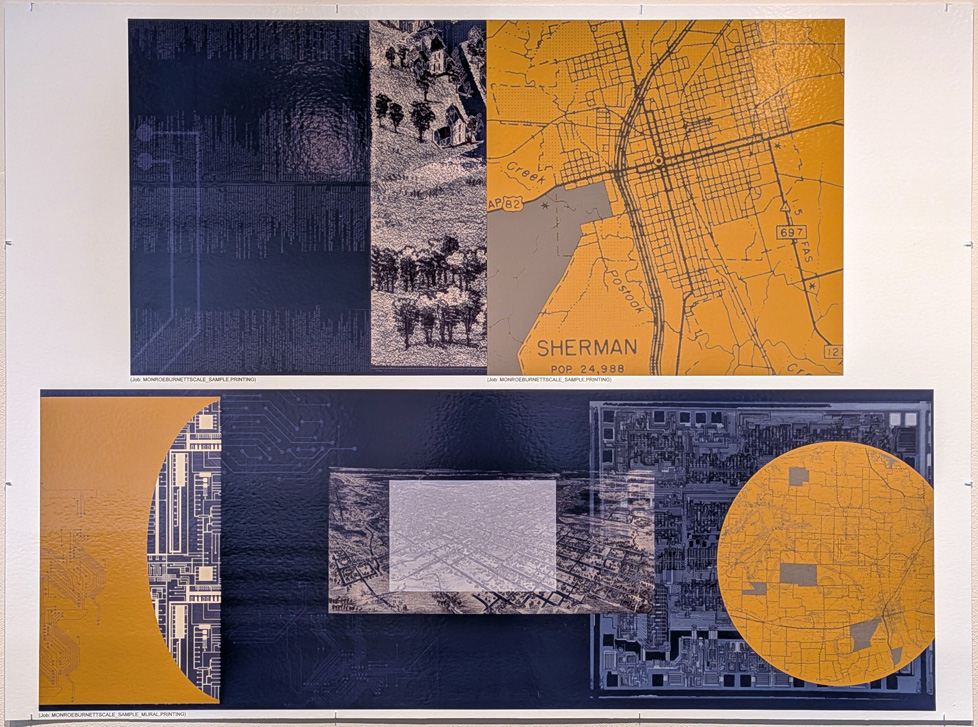 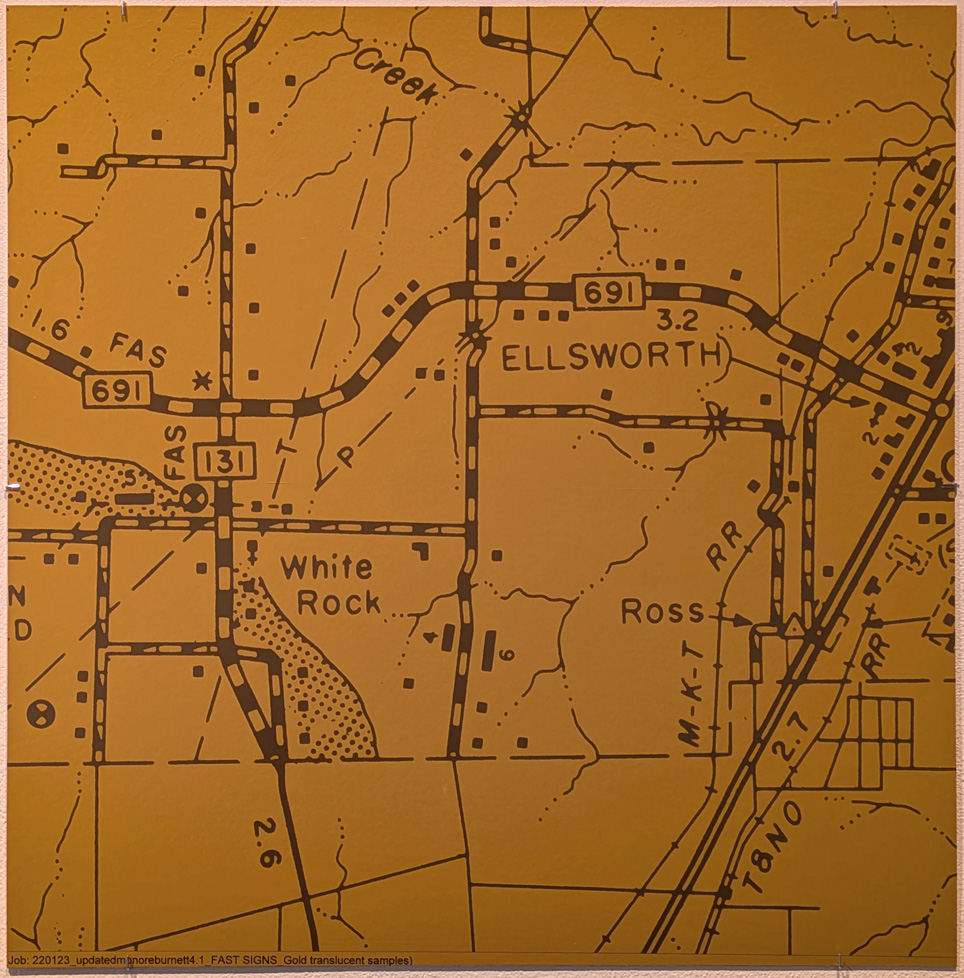 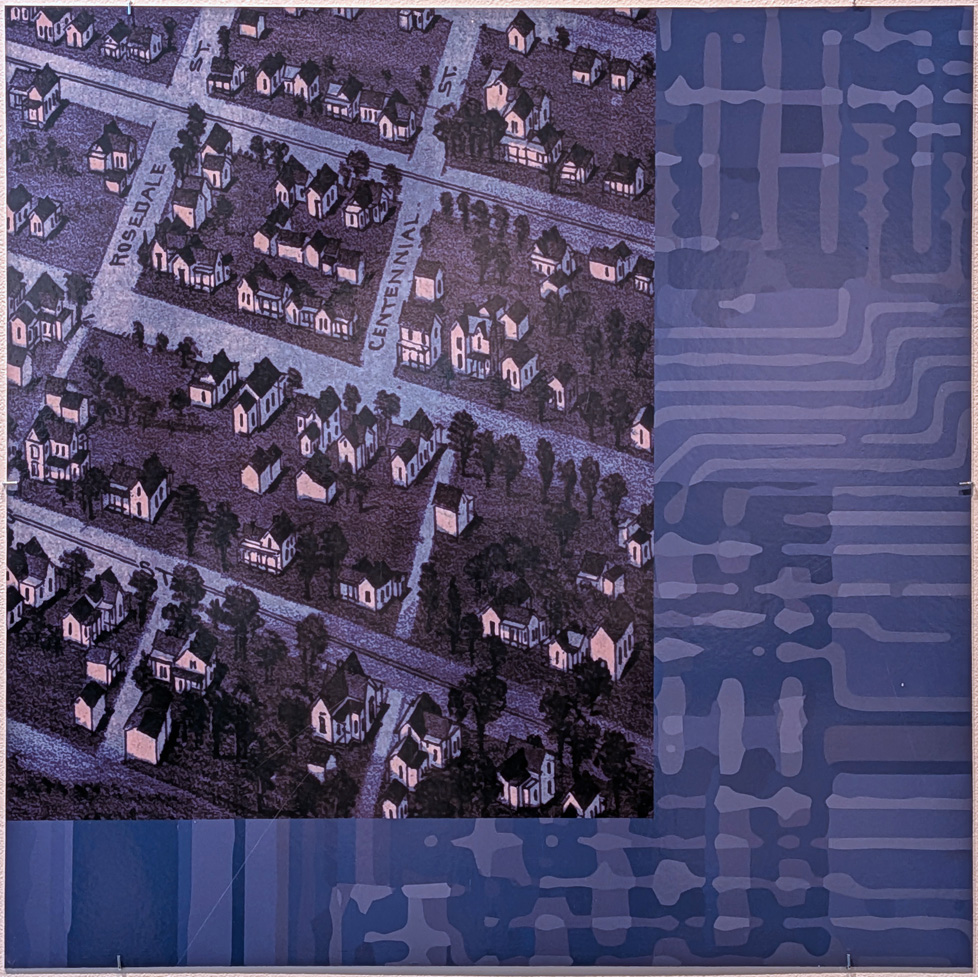 Sample Materials from vinyl installation Testing for color, surface, and scale, 5'x7' 2025 |
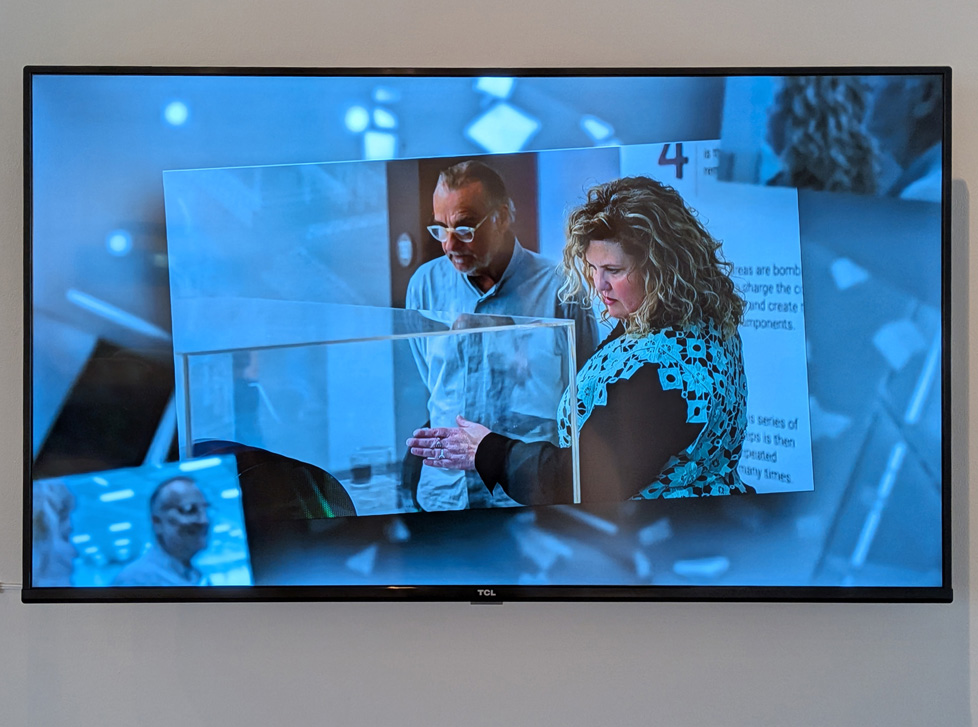 (Click on the photo to see video on Youtube.) |
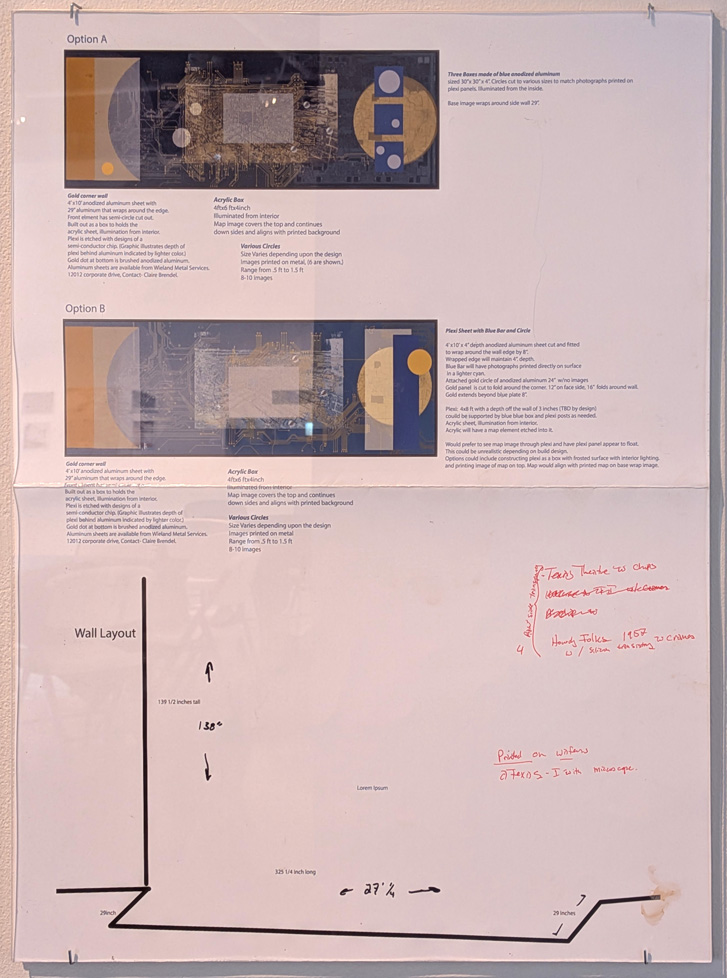 Option A Gold corner wall 4' x10' anodized aluminum sheet with 29" aluminum that wraps around the edge. Front element has semi-circle cut out. Built out as a box to hold the acrylic sheet, illumination from interior. Plexi is etched with designs of a semi-conductor chip. (Graphic illustrates depth of plexi behind aluminum indicated by lighter color.) Gold dot at bottom is brushed anodized aluminum. Aluminum sheets are available from Wieland Metal Services. 12012 Corporate Drive, Contact- Claire Brendel. Acrylic Box 4ftx6 ftx4inch Illuminated from interior Map image covers the top and continues down sides and aligns with printed background Various Circles Size Varies depending upon the design Images printed on metal, (6 are shown.) Range from .5 ft to 1.5 ft 8-10 images Three Boxes made of blue anodized aluminum sized 30"x 30" x 4". Circles cut to various sizes to match photographs printed on plexi panels. Illuminated from the inside. Base image wraps around side wall 29". Option B Gold corner wall 4' x10' anodized aluminum sheet with 29" aluminum that wraps around the edge. Front element has semi-circle cut out. Built out as a box to hold the acrylic sheet, illumination from interior. Plexi is etched with designs of a semi-conductor chip. (Graphic illustrates depth of plexi behind aluminum indicated by lighter color.) Gold dot at bottom is brushed anodized aluminum. Aluminum sheets are available from Wieland Metal Services. 12012 Corporate Drive, Contact- Claire Brendel. Acrylic Box 4ftx6 ftx4inch Illuminated from interior Map image covers the top and continues down sides and aligns with printed background Various Circles Size Varies depending upon the design Images printed on metal Range from .5 ft to 1.5 ft 8-10 images Pixel Sheet with Blue Bar and Circle 4' x 10' x 4" depth anodized aluminum sheet cut and fitted to wrap around the wall edge by 8". Wrapped edge will maintain 4" depth. Blue Bar will have photographs printed directly on surface in a lighter cyan. Attached gold circle of anodized aluminum 24" w/no images Gold panel is cut to fold around the corner. 12" on face side, 16" folds around wall. Gold extends beyond blue plate 8". Plexi: 4x8 ft with a depth off the wall of 3 inches (TBD by design) could be supported by blue blue box and plexi posts as needed. Acrylic sheet, illumination from interior. Acrylic will have a map element etched into it. Would prefer to see map image through plexi and have plexi panel appear to float. This could be unrealistic depending on build design. Options could include constructing plexi as a box with frosted surface with interior lighting and printing image of map on top. Map would align with printed map on base wrap image. |
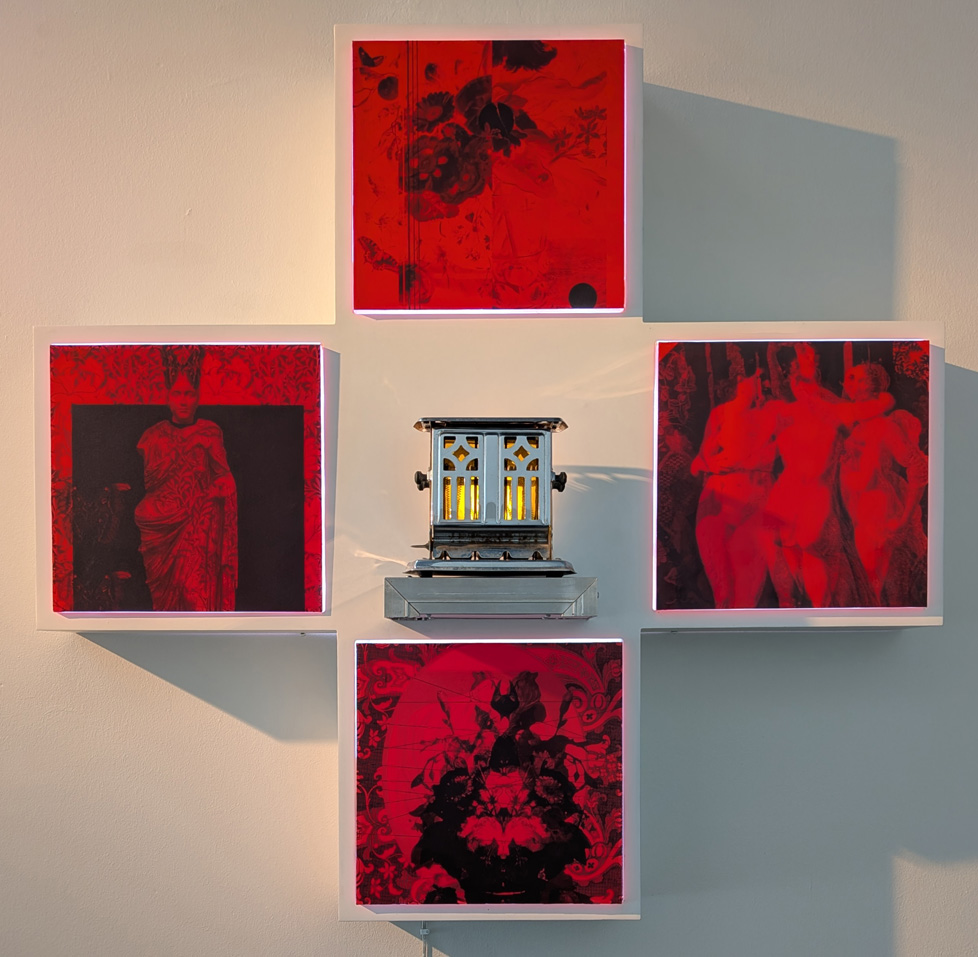 Alliterations Mark Monroe & Brianna Burnett 2024 (an example of an earlier collaboration) |