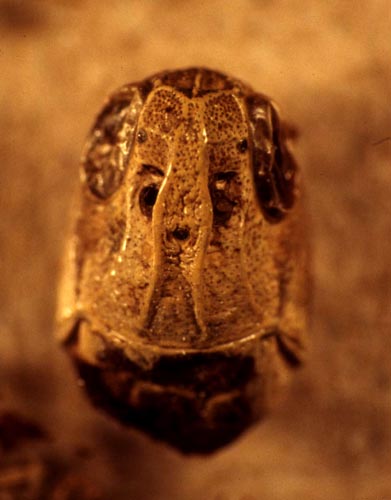
The "Granite
Grasshopper", Trimerotropis saxatilis, is found on rocky outcrops
throughout the southeastern US. There is a population of this species in
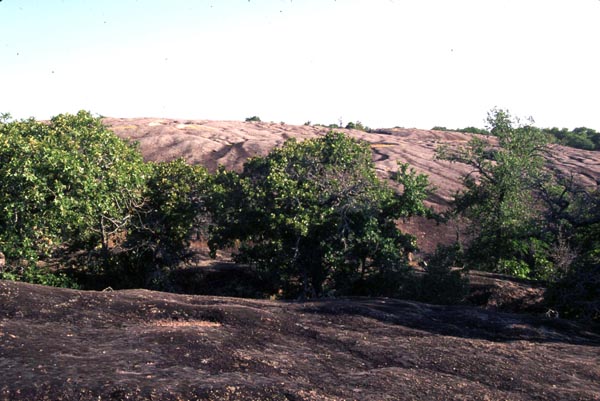
south-central Oklahoma, at a location known as "Ten-acre
rock". The Ten-acre rock is an outcrop of pre-Cambrian granite about
4 ha in area. There is little herbaceous or woody vegetation on the outcrop,
so the grasshoppers live on the surface of the rock itself, and in and
around shallow soil-filled depressions on the surface of the outcrop. In
addition to the main outcrop, there are several smaller and less accessible
outcrops (for instance "Six-acre rock"), which have had less human impact
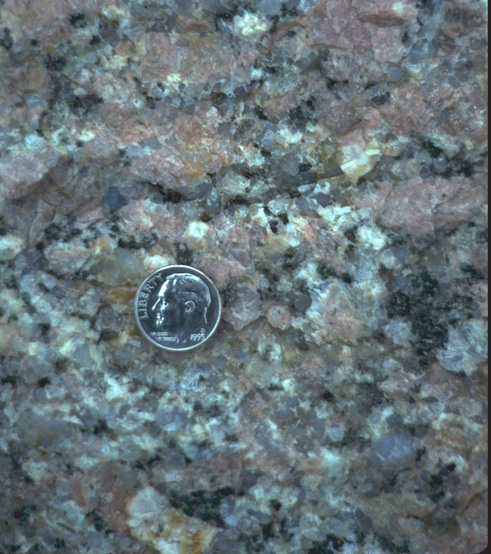
and are more interesting biologically. The granite
formed from magma that cooled slowly and deep within the earth's crust,
so is composed of large phenocrists of quartz, mica, and pink fledspar.
In many places the granite surface is partially covered by a crusting dark
gray and green lichens and also by a less common yellow lichen. Finally,
the granite surface may be stained dark gray or nearly black by standing
water or by runoff. All of this makes for a visually complex substrate
upon which the grasshoppers live.
The grasshoppers' life cycle begins in the early spring, when tiny nymphs hatch from eggs laid the previous summer. The nymphs feed on the limited amount of green vegetation that grows in the depressions, which support a relatively lush and dense growth of herbaceous plants from early spring into the summer (depending on conditions). The nymphs grow through three (maybe four) instars, and transform into adults in the early summer. Courtship and mating presumably begin soon after adults appear, but there are little data on this point, or on the duration of the breeding season. Egg-laying begins in early July, and continues into September or even October. Males have sperm in the testes well into the fall, although females probably store enough sperm in the spermatheca to continue fertilizing eggs until they die of old age. In general, all adults of one year die during the fall and winter, and the eggs overwinter.
Granite grasshoppers are sexually dimorphic in size, with females being significantly larger than males [female mean = 36.06 mm (s = 1.57, N = 166); male mean = 30.6 mm (s = 1.42, N = 174); t = 33.53, P << 0.001]. This pattern of dimorphism is a relatively common one, and is found in various invertebrates and vertebrates (e.g. snakes, turtles, some birds). The functional significance of female-biased sexual size dimorphism is apparently related to the need for greater body volume for production and in some cases brooding of eggs, which are obviously substantially larger than sperm. In addition to the size differences, females of T. saxatilis have obvious ovipositor valves at the posterior end of the abdomen which males lack. There are also behavioral differences between the genders. Both males and females perform a "leg-raising" display when approached by a member of their own gender. This display involves quickly raising one or both hind legs, then slowly lowering them with some "fluttering" up and down. Males seem to perform this display more commonly than females. When males approach females, they perform a different kind of display, which involves fluttering of the hind legs both while slowly raising and lowering them. Females do not respond to males' displays with displays of their own.
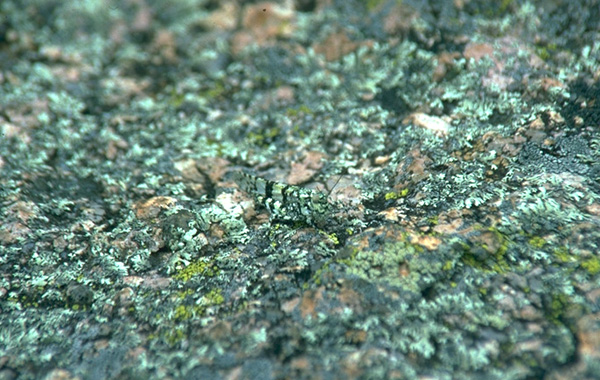
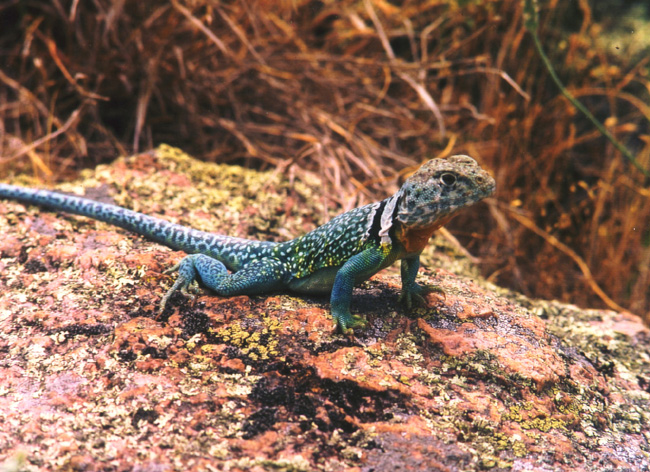
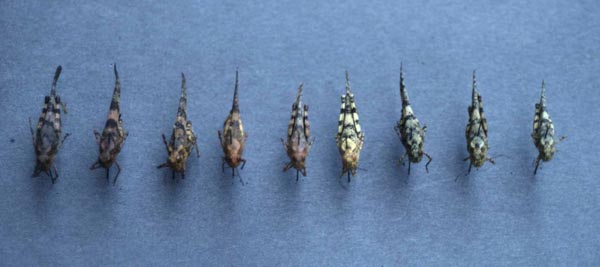
There is good evidence that at least one vertebrate species routinely preys on T. saxatilis. I have found more than one fecal pellet of the collared lizard, Crotaphytus collaris, which contained grasshopper exoskeletal fragments. Crotaphytus collaris is a relatively common inhabitant of the Ten-acre rock. These lizards are insectivores that hunt visually. Predation by this species poses a potential selection pressure on the grasshopper population, which has apparently responded by the evolution of cryptic coloration. The crypsis involves both vertical mottlings or broken stripes, which are dark gray, and a background color that matches the substrate color. However, because the substrate color is variable and fine grained (meaning that individual patches of pink, green, yellow, or gray are relatively small), the grasshoppers exhibit a polymorphism in the background color, which includes pink, green, yellow, and gray morphs, with some gradation between these character states. Evidence indicates that each individual grasshopper is genetically fixed for color, so that as grasshoppers develop from nymph to adult (they molt or shed the exoskeleton several times during this development), their color remains the same regardless of the color of the substrate they are on.
When disturbed by the approach of a human (and presumably of a predator), the grasshoppers jump and fly, which is the typical predator avoidance behavior of acridid grasshoppers in general. When a granite grasshopper lands, it folds its wings (which are a quite visible pale yellow) and drops to the granite surface, so almost disappears from sight. Anecdotal observations suggest that female grasshoppers fly farther than males on their first and subsequent jumps following initial and repeated disturbance. The reason for this difference is unknown; in fact there are few data that demonstrate that this difference exists consistently. The purpose of this lab exercise is to begin to document the jump distances of male and female grasshoppers, to test whether females do in fact jump farther than males.
Our methods for this test will be fairly simple. The grasshoppers are scattered haphazardly over the surface of the granite, and because they are cryptic it is difficult to detect them without disturbing them. My intention is for us to work in pairs or threes, and we will spread out over the surface of the rock so that each group does not interfere with the work of other groups. One individual in the group will carry an insect net, which can be swept back and forth while walking slowly across the rock. This will serve to disturb any grasshoppers that the group encounters. Another individual in the group will mark with colored chalk the initial location of the grasshopper. The other group members should watch the grasshopper to see where it lands, and then disturb it again, again marking its location with chalk, and again watching to see where it lands. Finally the grasshopper should be disturbed a third time time so that its third jump can be measured. Once the grasshopper's four locations (three jumps) have been marked, the group will use a tape measure to measure the length of the jumps, keeping the data for first, second, and third jumps separate, and keeping data for females separate from data for males.
How do you determine the gender of your observational subjects? It is
possible for a trained observer to determine gender with the naked eye
from a few meters distance, but you will probably want to either capture
the grasshopper to sex it (which is not as easy as it sounds) or use binoculars
to observe from a short distance. I will be available to make determinations
if you need me to.